HuagongsheHuagongshe Chemistry Print Report · For research reference only
Hydrochloric Acid → 3-(2,6-Dichlorobenzoyl)-1-(p-chlorophenyl)-hydantoin
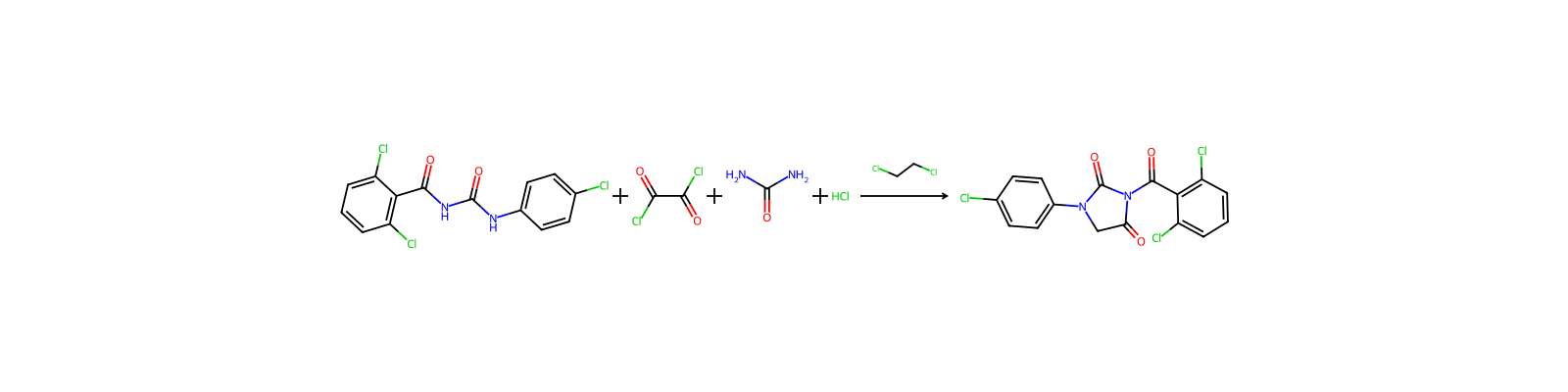
Participants
| Role | Name | HCID | Charge |
|---|---|---|---|
| Reactant | Hydrochloric Acid | HCID 313 | — |
| Reactant | Urea | HCID 1176 | — |
| Reactant | Oxalyl chloride | HCID 65578 | — |
| Reactant | 2,6-dichloro-N-(((4-chlorophenyl)amino)carbonyl)benzamide | HCID 92300 | — |
| Solvent | 1,2-Dichloroethane | HCID 11 | — |
| Product | 3-(2,6-Dichlorobenzoyl)-1-(p-chlorophenyl)-hydantoin | HCID 19006415 | — |
Reaction Steps
10.3 g of N-(2,6-dichlorobenzoyl)-N'-(p-chlorophenyl)-urea are boiled in 100 ml of dry 1,2-dichloroethane containing 3 ml of oxalylchloride for 24 hours. The urea dissolves with the evolution of hydrochloric acid. After concentration by evaporation and after the addition of 25 ml of ligroin the residue becomes crystalline. The substance mauy be recrystallized from 30 mls of benzene. Melting point 157° C. Yield 8 g.
Provenance & Evidence
| DOI | 10.6084/m9.figshare.5104873.v1 |
|---|---|
| Patent number | US05142064 |
| Source dataset | uspto-grants-1992_08 |
| ORD ID | ord-1d4e2ea2bb504f7b8f8c05fc2fff3709 |
| Source note | uspto-grants-1992_08 |