Water → 4-(dodecanoylamino)benzoic acid
Reaction equation

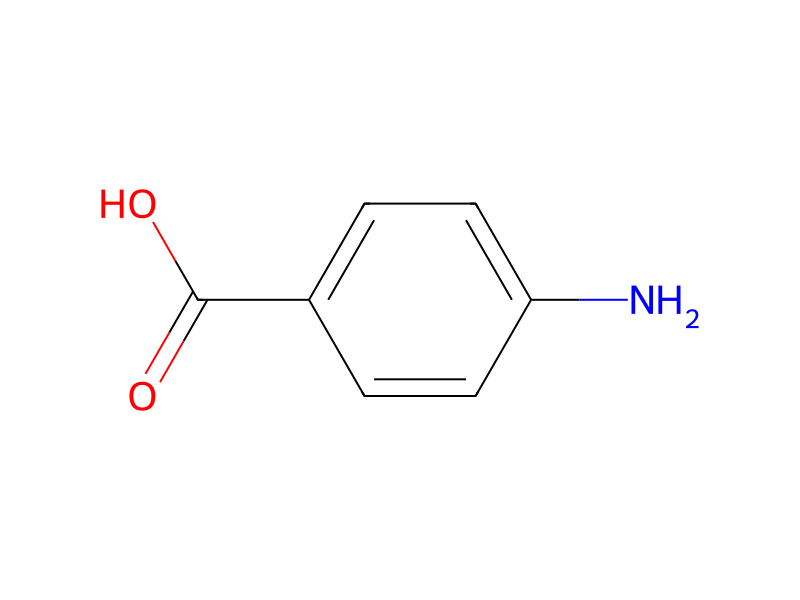
[C:1](Cl)(=[O:13])[CH2:2][CH2:3][CH2:4][CH2:5][CH2:6][CH2:7][CH2:8][CH2:9][CH2:10][CH2:11][CH3:12].[NH2:15][C:16]1[CH:24]=[CH:23][C:19]([C:20]([OH:22])=[O:21])=[CH:18][CH:17]=1.O>N1C=CC=CC=1>[C:1]([NH:15][C:16]1[CH:24]=[CH:23][C:19]([C:20]([OH:22])=[O:21])=[CH:18][CH:17]=1)(=[O:13])[CH2:2][CH2:3][CH2:4][CH2:5][CH2:6][CH2:7][CH2:8][CH2:9][CH2:10][CH2:11][CH3:12]Participants
5
Reactant 3


Product 1

Reagents, catalysts & solvents 1

Procedure
n-Dodecanoyl chloride (8.74 g; 40 mmoles) is added dropwise to a solution of p-aminobenzoic acid (5.5 g; 40 mmoles) dissolved in pyridine (100 ml). The mixture is stirred for 3 hours and poured into water (3 L). The precipitate which forms is filtered and dried in vacuo to give N-(n-dodecanoyl)-p-aminobenzoic acid (11.01 g).
Workup
- filtrationThe precipitate which forms is filtered
- customdried in vacuo
Sources & evidence
- ORD record
- ord-91ea9e30b3b74fd0a8df91a40e7d9ef6
- Source dataset
- uspto-grants-1981_10
- Patent number
- US04293482
Reaction notes
Loading…