Iodine → HCID 54056135, compound
Reaction equation

[C:1]([O-:4])(=[O:3])[CH3:2].[C:5]([O-:8])(=[O:7])[CH3:6].[C:9]([O-:12])(=O)[CH3:10].[C:13]([O-])(=O)[CH3:14].[Pb+4].C(=O)([O-])[O-].[Ca+2].C(O[C@H:27]1[CH2:46][C@@]2(C)[C@@H:38]([CH2:39][CH2:40][C@@H:41]2[CH:42]([OH:44])[CH3:43])[C@H:37]2[C@H:28]1[C@:29]1([CH3:52])[C:34](=[CH:35][CH2:36]2)[CH2:33]C2(OCCO2)C[CH2:30]1)(=O)C.II.CC(C)=O.OS(O)(=O)=O.O=[Cr](=O)=O>C1CCCCC1.CC(C)=O>[C:1]([O:4][C@H:27]1[CH2:46][C@@:10]2([CH2:9][OH:12])[C@@H:38]([CH2:39][CH2:40][C@@H:41]2[C:42](=[O:44])[CH3:43])[C@H:37]2[C@H:28]1[C@:29]1([CH3:52])[C:34](=[CH:35][CH2:36]2)[CH2:33][C:5]2([O:8][CH2:14][CH2:13][O:7]2)[CH2:6][CH2:30]1)(=[O:3])[CH3:2]Participants







Procedure
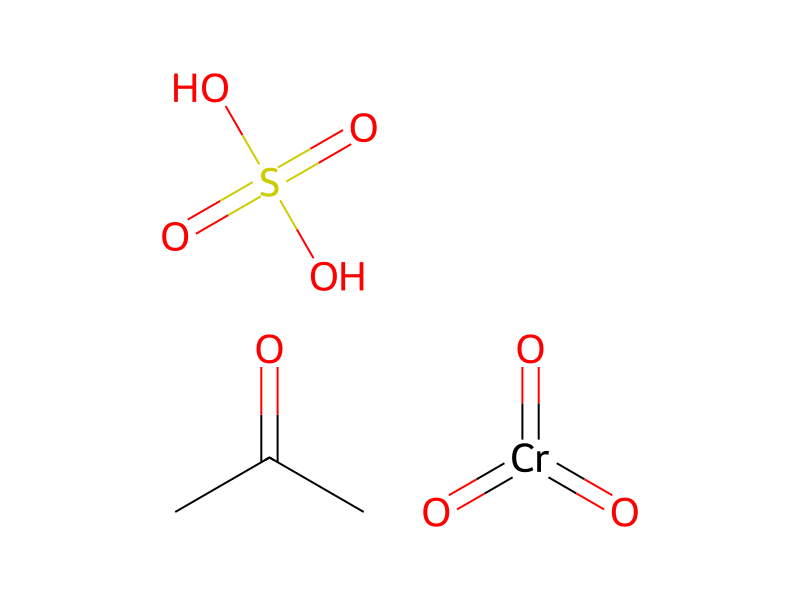
A mixture of 21.7 g of lead tetraacetate and 9.8 g of calcium carbonate in 1000 ml of cyclohexane is heated at reflux under argon for 1 hour and then cooled. To the resulting suspension is added 8.2 g of 11β-acetoxy-3,3-ethylenedioxypregn-5-en-20-ol and 2.5 g of iodine and the resulting purple suspension is heated to reflux and irradiated with a 275 W sunlamp until the color of the iodine has faded (1-1.5 hours). The mixture is then cooled and filtered through Celite and the filtrate is washed with aqueous sodium bisulfite, water, aqueous sodium bicarbonate and brine. The organic solution is then dried and concentrated and the residue obtained is dissolved in acetone and treated with 10 ml of standard Jones reagent at 0° C. for 1 hour. Excess Jones reagent is destroyed by the addition of 2-propanol and the resulting mixture is filtered to remove the precipitated inorganic salts. The filtrate is then concentrated to a small volume and the residue is partitioned between ether and water. The aqueous solution is extracted with ether and the ether solutions are combined, washed with aqueous sodium bicarbonate, dried and concentrated. The residue is dissolved in water:dioxane (1:9, 700 ml) and 7.2 g of silver acetate is added. The mixture is stirred and heated rapidly to 60°-65° C. and then maintained at that temperature for 4 hours. The mixture is then cooled, filtered and concentrated. The residue is dissolved in ether, filtered again and concentrated. The resulting material is chromatographed on silica gel to give 11β-acetoxy-3,3-ethylenedioxy-18-hydroxypregn-5-en-20-one.
Workup
- temperatureis heated
- temperatureat reflux under argon for 1 hour
- temperaturecooled
- temperaturethe resulting purple suspension is heated
- temperatureto reflux
- custom(1-1.5 hours)
- temperatureThe mixture is then cooled
- filtrationfiltered through Celite
- washthe filtrate is washed with aqueous sodium bisulfite, water, aqueous sodium bicarbonate and brine
- customThe organic solution is then dried
- concentrationconcentrated
- customthe residue obtained
- customExcess Jones reagent is destroyed by the addition of 2-propanol
- filtrationthe resulting mixture is filtered
- customto remove the precipitated inorganic salts
- concentrationThe filtrate is then concentrated to a small volume
- customthe residue is partitioned between ether and water
- extractionThe aqueous solution is extracted with ether
- washwashed with aqueous sodium bicarbonate
- customdried
- concentrationconcentrated
- dissolutionThe residue is dissolved in water:dioxane (1:9, 700 ml)
- addition7.2 g of silver acetate is added
- temperatureheated rapidly to 60°-65° C.
- temperaturemaintained at that temperature for 4 hours
- temperatureThe mixture is then cooled
- filtrationfiltered
- concentrationconcentrated
- dissolutionThe residue is dissolved in ether
- filtrationfiltered again
- concentrationconcentrated
- customThe resulting material is chromatographed on silica gel
Sources & evidence
- ORD record
- ord-f34919c86bcd4d6ca9f81464bb25416f
- Source dataset
- uspto-grants-1981_10
- Patent number
- US04293548
Reaction notes
Loading…