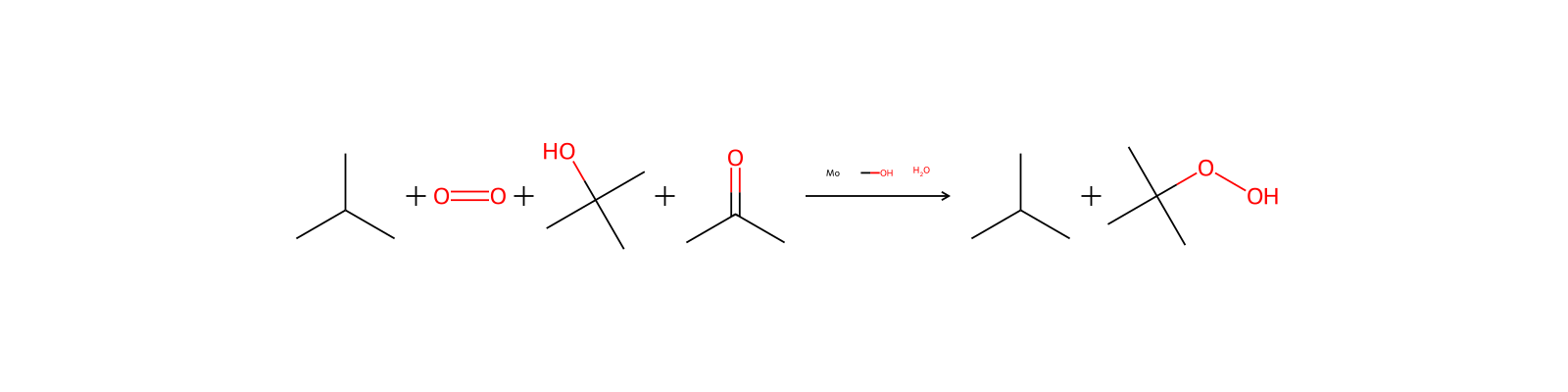
Participants
| Role | Name | HCID | Charge |
|---|
| Reactant | Acetone | HCID 180 | — |
| Reactant | Oxygen | HCID 977 | — |
| Reactant | Isobutane | HCID 6360 | — |
| Reactant | tert-Butanol | HCID 6386 | — |
| Catalyst | Molybdenum | HCID 23932 | — |
| Solvent | Methanol | HCID 887 | — |
| Solvent | Water | HCID 962 | — |
| Product | Isobutane | HCID 6360 | — |
| Product | tert-Butyl hydroperoxide | HCID 6410 | 22% |
Reaction Conditions
| Temperature | 280 fahrenheit |
|---|
Reaction Steps
The oxidation zone is in a pressurized reactor which is partially filled with a liquid reaction mixture comprising 5 ppm of soluble molybdenum catalyst. The liquid reaction mixture can be deemed to be about 66% isobutane and about 34% of a liquid mixture of oxidate, comprising products and byproducts. Fresh isobutane is injected and recycle isobutane is injected into the liquid reaction mixture. An oxygen-containing gas is injected into the liquid reaction mixture. The reactor is maintained at 700 psig and at 280° F. The average residence time for the isobutane in the reactor is about 4 hours, and the extent of conversion of the isobutane is about 34%. The yields of byproducts and products from such oxidation of isobutane correspond to about 66% tertiary butyl alcohol (TBA), about 22% tertiary butyl hydroperoxide (TBHP), about 6% acetone, about 6% of a mixture comprising about 2% water, about 1.5% methanol and minor amounts of related components. About 1% of the isobutane is converted to carbon dioxide with a measurable amount of carbon monoxide.
Provenance & Evidence
| DOI | 10.6084/m9.figshare.5104873.v1 |
|---|
| Patent number | US04294999 |
|---|
| Source dataset | uspto-grants-1981_10 |
|---|
| ORD ID | ord-0efdab1014ce4e21aaa9cc32261a65ce |
|---|
| Source note | uspto-grants-1981_10 |
|---|