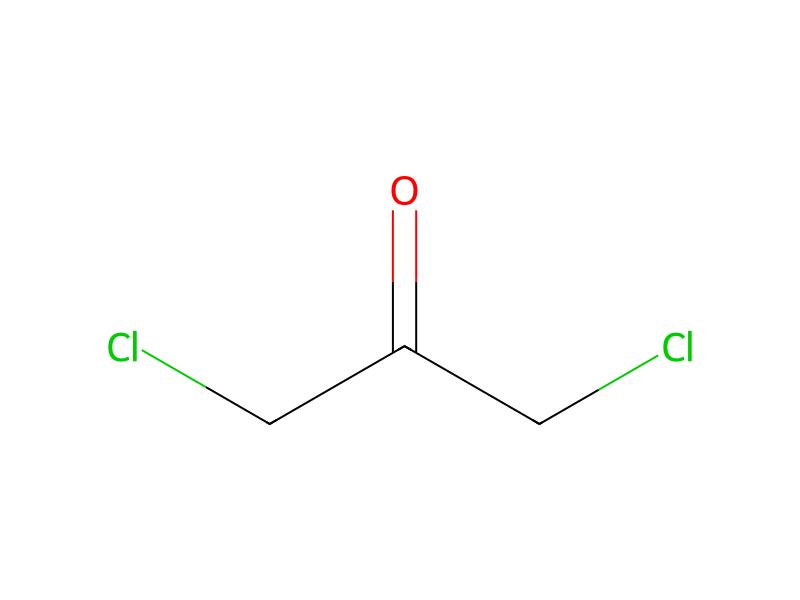
1,3-Dichloroacetone → HCID 19367122, compound
Reaction equation

[NH2:1][C:2]1[CH:7]=[CH:6][C:5]([O:8][CH3:9])=[CH:4][N:3]=1.[Cl:10][CH2:11][C:12]([CH2:14]Cl)=O>C(COC)OC>[Cl:10][CH2:11][C:12]1[N:1]=[C:2]2[CH:7]=[CH:6][C:5]([O:8][CH3:9])=[CH:4][N:3]2[CH:14]=1Participants
Reactant 2

Product 1

Reagents, catalysts & solvents 1

Conditions
- Temperature
- 80 °C
Procedure
A mixture of 2-amino-5-methoxypyridine (0.5036 g; prepared by the method of Lombardino, J. Med. Chem. 1981, 24 39-42), 1,3-dichloroacetone (Aldrich; 0.3935 g), and dimethoxyethane (2.5 mL) is stirred overnight at room temperature. The mixture is concentrated under reduced pressure and ethanol (7.9 mL) is added. After the mixture has stirred for 30 min at 80° C., it is cooled and concentrated under reduced pressure. The residue is partitioned between dichloromethane and saturated aq. sodium bicarbonate and the combined organic layers are dried with MgSO4 and concentrated under reduced pressure. The residue is chromatographed on silica gel using methanol/dichloromethane (4/96) to give 0.1392 g of 2-(chloromethyl)-6-methoxyimidazo[1,2-a]pyridine; 1H NMR (CDCl3) δ 3.82, 4.75, 6.99, 7.48, 7.56, 7.59.
Workup
- customprepared by the method of Lombardino, J
- concentrationThe mixture is concentrated under reduced pressure and ethanol (7.9 mL)
- additionis added
- temperatureit is cooled
- concentrationconcentrated under reduced pressure
- customThe residue is partitioned between dichloromethane and saturated aq. sodium bicarbonate
- dry with materialthe combined organic layers are dried with MgSO4
- concentrationconcentrated under reduced pressure
- customThe residue is chromatographed on silica gel
Sources & evidence
- ORD record
- ord-88fae60c51154777a3ecc6f731d72227
- Source dataset
- uspto-grants-2000_01
- Patent number
- US06013654
Reaction notes
Loading…