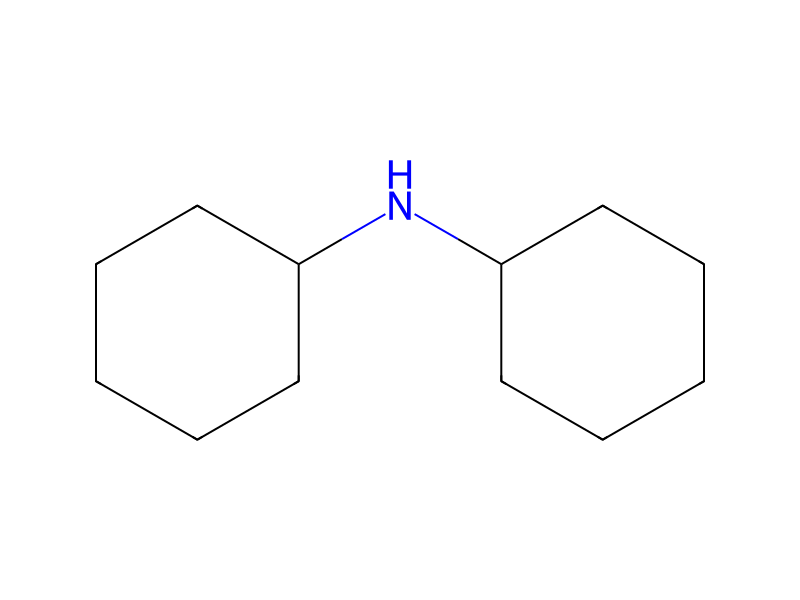
Aniline → Dicyclohexylamine
Reaction equation

[NH2:1][C:2]1[CH:7]=[CH:6][CH:5]=[CH:4][CH:3]=1>[Ru].C1CCCCC1>[CH:2]1([NH2:1])[CH2:7][CH2:6][CH2:5][CH2:4][CH2:3]1.[CH:2]1([NH:1][CH:2]2[CH2:7][CH2:6][CH2:5][CH2:4][CH2:3]2)[CH2:7][CH2:6][CH2:5][CH2:4][CH2:3]1Participants
5
Reactant 1

Product 2

Reagents, catalysts & solvents 2


Procedure
It has now surprisingly been found that aniline can be efficiently hydrogenated over a ruthenium catalyst to produce cyclohexylamine with a minimum amount of byproduct dicyclohexylamine or cyclohexane by operating at a temperature of from 160° to 180° C. and by including from about 1 to about 8 parts by weight of ammonia per 100 parts aniline by weight in the charge. Moderate hydrogen pressures of from about 2 MPa to 5 MPa can be employed, and the reaction proceeds smoothly to completion in one half hour to four hours, with no rapid rise in temperature or localized heating. The ruthenium catalyst does not appear to be poisoned by the ammonia, and can be recycled a number of times.
Sources & evidence
- ORD record
- ord-5dcda1bdf9ed4efcbec2b5eda58fedef
- Source dataset
- uspto-grants-1983_05
- Patent number
- US04384142
Reaction notes
Loading…