Acetone → HCID 69517938, compound
Reaction equation

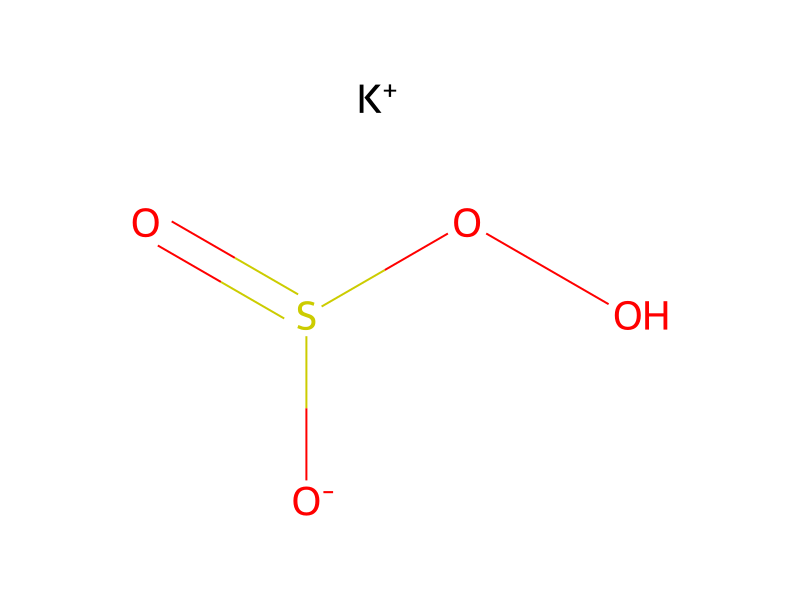
[Cl:1][C:2]1[CH:3]=[C:4]2[C:9](=[CH:10][C:11]=1[S:12][CH2:13][CH:14]([CH3:16])[CH3:15])[O:8][CH:7]([C:17]([F:20])([F:19])[F:18])[C:6]([C:21]([OH:23])=[O:22])=[CH:5]2.[OH:24]OS([O-])=O.[K+].[CH3:30][C:31](C)=O>O>[Cl:1][C:2]1[CH:3]=[C:4]2[C:9](=[CH:10][C:11]=1[S:12]([CH2:13][CH:14]([CH3:16])[CH3:15])=[O:24])[O:8][CH:7]([C:17]([F:20])([F:19])[F:18])[C:6]([C:21]([O:23][CH2:30][CH3:31])=[O:22])=[CH:5]2Participants
Reactant 3


Product 1

Reagents, catalysts & solvents 1

Conditions
- Temperature
- 0 °C
Procedure
The Ethyl 6-chloro-7-(isobutylthio)-2-(trifluoromethyl)-2H-chromene-3-carboxylate (Example 7d) (0.47 g, 1.19 mmole) was dissolved in a mixture of acetone (10 mL) and water (10 mL) and cooled to 0° C. (ice bath). The reaction was treated with oxone (0.73 g, 1.19 mmole) and stirred at 0° C. for 10 minutes followed by warming to room temperature for 4 hours. The reaction mixture was diluted with water (20 mL) and extracted with EtOAc (2×50 mL). The combined extracts were washed with brine (50 mL), dried over MgSO4, filtered and concentrated in vacuo to give a yellow solid which was subject to HPLC (reverse phase) and eluted with 50-95% ACN/water with 0.05% TFA to give a yellow solid (0.4 g, 82%): LCMS m/z 411.0 (M+H). 1H NMR (CDCl3/400 MHz) 7.65 (s, 1H), 7.54 (s, 1H), 7.24 (s, 1H), 5.73 (q, 1H, J=7.0 Hz), 4.30 (m, 2H), 2.90 (m, 1H), 2.70 (m, 1H), 2.38 (m, 1H), 1.33 (m, 3H), 1.20 (m, 3H), 1.07 (m, 3H).
Workup
- temperatureby warming to room temperature for 4 hours
- extractionextracted with EtOAc (2×50 mL)
- washThe combined extracts were washed with brine (50 mL)
- dry with materialdried over MgSO4
- filtrationfiltered
- concentrationconcentrated in vacuo
- customto give a yellow solid which
- washeluted with 50-95% ACN/water with 0.05% TFA
Sources & evidence
- ORD record
- ord-5bedab79fdce439a8749d9586daee5d3
- Source dataset
- uspto-grants-2007_08
- Patent number
- US07259266B2
Reaction notes
Loading…