Phosphine, triphenyl-, hydrobromide → 4-Bromo-2-chloro-1-isopropenylbenzene
Reaction equation
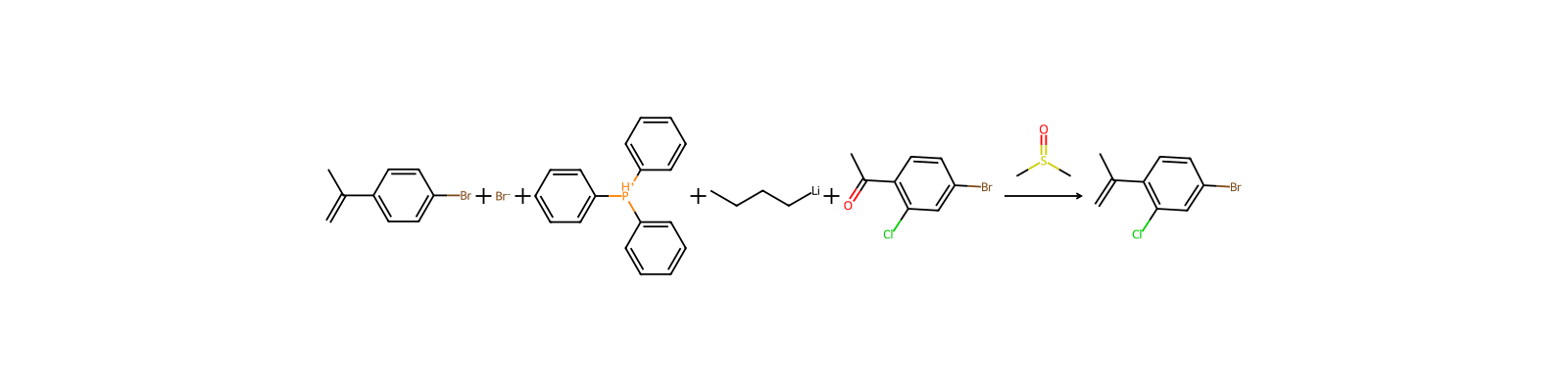
[Br:1][C:2]1[CH:7]=[CH:6][C:5]([C:8]([CH3:10])=[CH2:9])=[CH:4][CH:3]=1.[Br-].C1([PH+](C2C=CC=CC=2)C2C=CC=CC=2)C=CC=CC=1.[Li]CCCC.BrC1C=CC(C(=O)C)=C([Cl:46])C=1>CS(C)=O>[Br:1][C:2]1[CH:7]=[CH:6][C:5]([C:8]([CH3:10])=[CH2:9])=[C:4]([Cl:46])[CH:3]=1Participants
6
Reactant 4



Product 1

Reagents, catalysts & solvents 1

Procedure
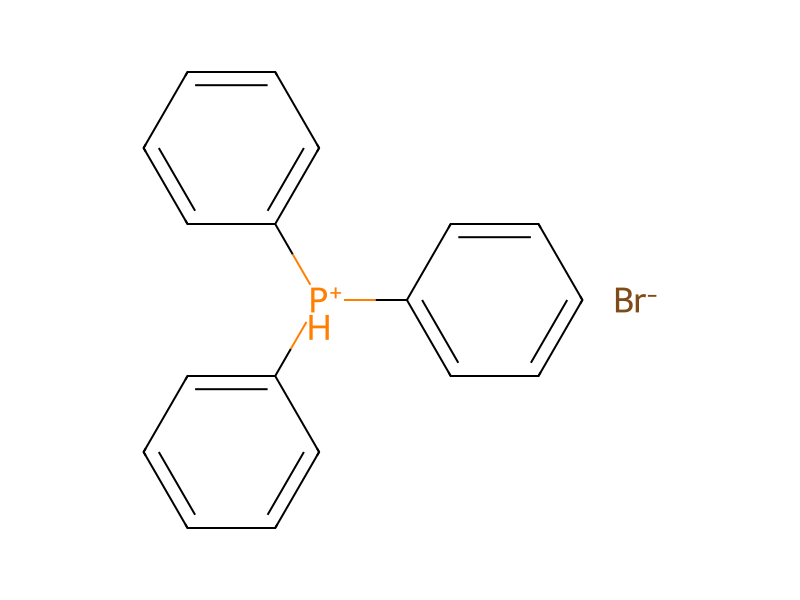
The title compound was synthesized in analogy to 1-bromo-4-isopropenylbenzene (described in example S87) using triphenylphosphonium bromide (2.32 g, 6.51 mmol), nBuLi (5.09 ml, 1.6M solution in hexane, 8.14 mmol) and 1-(4-bromo-2-chlorophenyl)-ethanone (1.52 g, 6.51 mmol) in DMSO (7 ml). The residue which was isolated was purified by filtration through a short pad of silica using pentane as eluant to give 4-bromo-2-chloro-1-isopropenylbenzene (750 mg, 50%) as a colorless oil. 1H NMR (CDCl3, 300 MHz): δ 7.51 (d, J=2.0 Hz, 1H), 7.34 (dd, J=2.0, 8.0 Hz, 1H), 7.07 (d, J=8.0 Hz, 1H), 5.24 (m, 1H), 4.96 (m, 1H), 2.07 (m, 3H).
Workup
- customThe residue which was isolated
- filtrationwas purified by filtration through a short pad of silica
Sources & evidence
- ORD record
- ord-d511431d943e46b1b15f4ad7f5c8f964
- Source dataset
- uspto-grants-2007_08
- Patent number
- US07259183B2
Reaction notes
Loading…