Triethylsilane → 1-Bromo-4-cyclobutylbenzene
Reaction equation

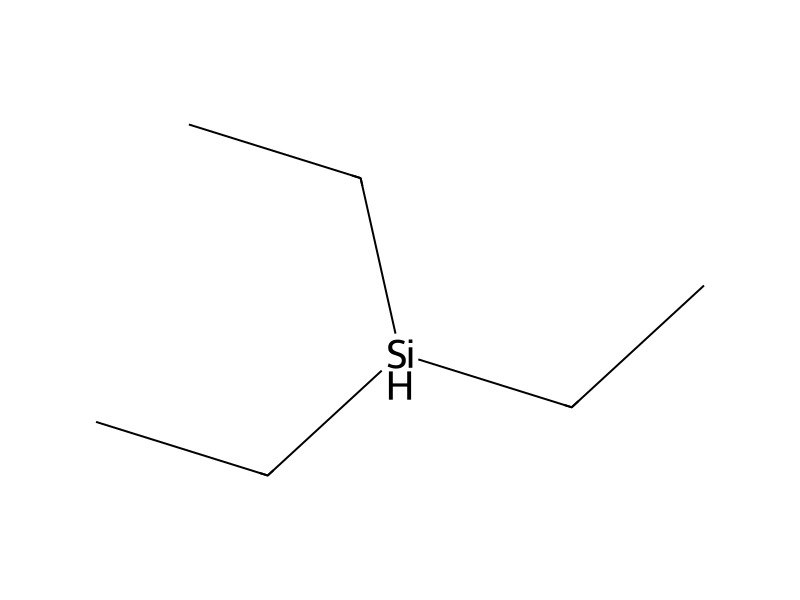
[Br:1][C:2]1[CH:7]=[CH:6][C:5]([C:8]2(O)[CH2:11][CH2:10][CH2:9]2)=[CH:4][CH:3]=1.C([SiH](CC)CC)C>C(Cl)Cl>[Br:1][C:2]1[CH:7]=[CH:6][C:5]([CH:8]2[CH2:11][CH2:10][CH2:9]2)=[CH:4][CH:3]=1Participants
Reactant 2

Product 1

Reagents, catalysts & solvents 1

Conditions
- Temperature
- -78 °C
Procedure
To a solution of 1.37 g of 1-(4-bromophenyl)-cyclobutanol (6 mmol) (prepared as described in example S97) in 15 ml DCM were added 1.15 ml of triethylsilane (7.2 mmol) and the mixture was cooled to −78° C. Then 1.15 ml of boron trifluoride diethyl etherate complex were added and the reaction mixture was warmed to −40° C. and stirred for 8 h. The reaction was then quenched by addition of 10% aqueous KHCO3 and the mixture was extracted three times with DCM. The combined extracts were washed with brine, dried with magnesium sulfate and concentrated. The remaining residue was purified by column chromatography (silica gel; cyclohexane) to give 0.84 g (66%) of 1-bromo-4-cyclobutyl-benzene as a colorless liquid. 1H NMR (CDCl3, 300 MHz): δ 1.85 (m, 1H), 1.92-2.18 (m, 3H), 2.33 (m, 2H), 3.49 (quint, J=8.5 Hz, 1H), 7.08 (d, J=8.5 Hz, 2H), 7.40 (d, J=8.5 Hz, 2H).
Workup
- additionThen 1.15 ml of boron trifluoride diethyl etherate complex were added
- temperaturethe reaction mixture was warmed to −40° C.
- customThe reaction was then quenched by addition of 10% aqueous KHCO3
- extractionthe mixture was extracted three times with DCM
- washThe combined extracts were washed with brine
- dry with materialdried with magnesium sulfate
- concentrationconcentrated
- customThe remaining residue was purified by column chromatography (silica gel; cyclohexane)
Sources & evidence
- ORD record
- ord-b812c8ac7101414798d1cf42c88b060b
- Source dataset
- uspto-grants-2007_08
- Patent number
- US07259183B2
Reaction notes
Loading…