Pyridine → 4-(4-Chlorophenyl)-1,2,3,6-tetrahydropyridine-1-carbonylchloride
Reaction equation

Cl.[Cl:2][C:3]1[CH:8]=[CH:7][C:6]([C:9]2[CH2:10][CH2:11][NH:12][CH2:13][CH:14]=2)=[CH:5][CH:4]=1.N1C=CC=CC=1.[Cl:21][C:22](Cl)([O:24]C(=O)OC(Cl)(Cl)Cl)Cl>C1(C)C=CC=CC=1.C(OCC)C>[Cl:2][C:3]1[CH:8]=[CH:7][C:6]([C:9]2[CH2:14][CH2:13][N:12]([C:22]([Cl:21])=[O:24])[CH2:11][CH:10]=2)=[CH:5][CH:4]=1Participants
6


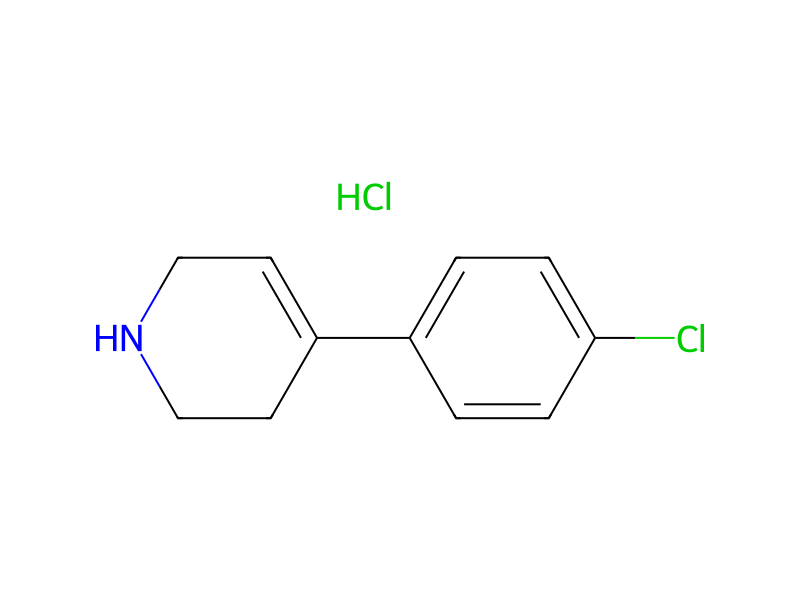



Procedure
A mixture of 4-(4-chlorophenyl)-1,2,3,6-tetrahydropyridine hydrochloride (1 g, 4.3 mmol), pyridine (680 mg, 8.6 mmol), and triphosgene (430 mg, 1.45 mmol) in toluene (20 ml) was heated under reflux for 3 hours. The reaction mixture was allowed to return to room temperature and diluted with diethyl ether. The mixture was washed with 10% hydrochloric acid, water and brine in this order, and dried over magnesium sulfate. After filtration, the filtrate was concentrated under reduced pressure to afford 4-(4-chlorophenyl)-1,2,3,6-tetrahydropyridine-1-carbonylchloride (1 g, yield 90%) as a yellow oil.
Workup
- temperaturewas heated
- temperatureunder reflux for 3 hours
- customto return to room temperature
- washThe mixture was washed with 10% hydrochloric acid, water and brine in this order
- dry with materialdried over magnesium sulfate
- filtrationAfter filtration
- concentrationthe filtrate was concentrated under reduced pressure
Sources & evidence
- ORD record
- ord-fccdbdab5e1d4114bd31d758fb9865fc
- Source dataset
- uspto-grants-2007_08
- Patent number
- US07262212B2
Reaction notes
Loading…