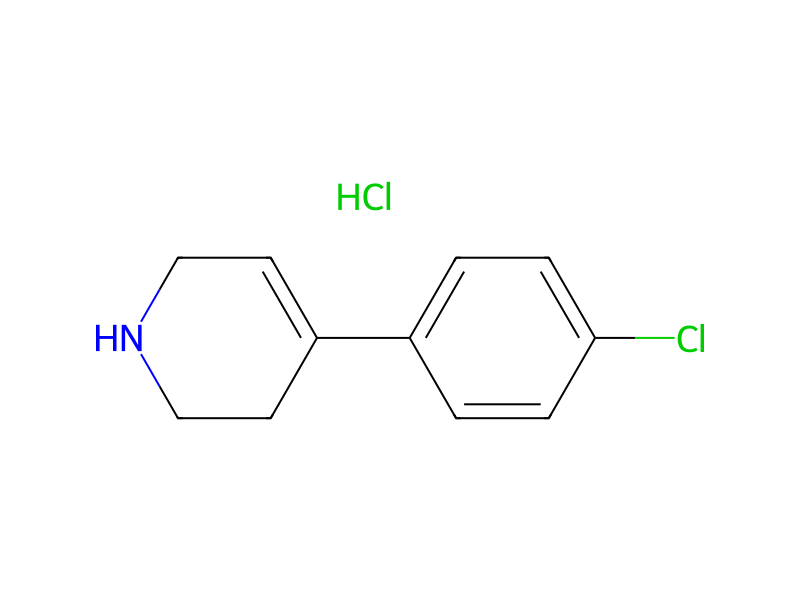
4-(4-Chlorophenyl)-1,2,3,6-tetrahydropyridinium chloride → 4-(4-chlorophenyl)piperidine Hydrochloride
Reaction equation

Cl.[Cl:2][C:3]1[CH:8]=[CH:7][C:6]([C:9]2[CH2:10][CH2:11][NH:12][CH2:13][CH:14]=2)=[CH:5][CH:4]=1.[H][H]>C(O)C.[Pt]=O>[ClH:2].[Cl:2][C:3]1[CH:8]=[CH:7][C:6]([CH:9]2[CH2:10][CH2:11][NH:12][CH2:13][CH2:14]2)=[CH:5][CH:4]=1Participants
5




Procedure
A mixture of 4-(4-chlorophenyl)-1,2,3,6-tetrahydropyridine hydrochloride (2 g, 8.7 mmol) and platinum oxide (100 mg) in ethanol (100 ml) was stirred at room temperature under an atmospheric pressure of hydrogen. The reaction mixture was filtered through Celite, and the filtrate was concentrated under reduced pressure. The resulting precipitates by treating the residue with diethyl ether were collected by filtration to afford 4-(4-chlorophenyl)piperidine hydrochloride (1.9 g, yield 94%) as a pale gray powder.
Workup
- filtrationThe reaction mixture was filtered through Celite
- concentrationthe filtrate was concentrated under reduced pressure
- customThe resulting precipitates
- additionby treating the residue with diethyl ether
- filtrationwere collected by filtration
Sources & evidence
- ORD record
- ord-986537e547394dc19eb3469893a6a1b0
- Source dataset
- uspto-grants-2007_08
- Patent number
- US07262212B2
Reaction notes
Loading…