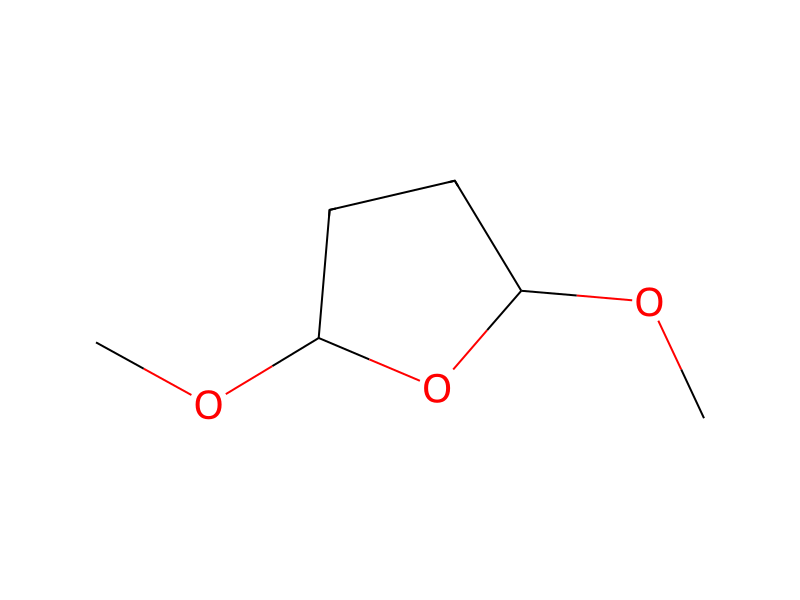
2,5-Dimethoxytetrahydrofuran → HCID 10447501, compound
Reaction equation

[NH2:1][C:2]1[CH:11]=[C:10]2[C:5]([NH:6][C:7](=[O:15])[C:8](=[O:14])[N:9]2[CH2:12][CH3:13])=[CH:4][C:3]=1[N+:16]([O-:18])=[O:17].CO[CH:21]1[CH2:25][CH2:24][CH:23](OC)O1>C(O)(=O)C>[CH2:12]([N:9]1[C:10]2[C:5](=[CH:4][C:3]([N+:16]([O-:18])=[O:17])=[C:2]([N:1]3[CH:21]=[CH:25][CH:24]=[CH:23]3)[CH:11]=2)[NH:6][C:7](=[O:15])[C:8]1=[O:14])[CH3:13]Participants
4
Reactant 2

Product 1

Reagents, catalysts & solvents 1

Procedure
0.9 g (3.5 mmol) of 7-amino-1-ethyl-6-nitro-2,3(1H,4H)-quinoxalinedione and 0.58 g (4.4 mmol) of 2,5-dimethoxytetrahydrofuran in 20 ml of acetic acid were refluxed for 2 h. The mixture was then concentrated under reduced pressure, and the residue was purified by chromatography on silica gel (mobile phase: toluene/acetone/acetic acid=10:10:1) to yield 0.7 g (68%) of the product. Melting point >300° C.
Workup
- concentrationThe mixture was then concentrated under reduced pressure
- customthe residue was purified by chromatography on silica gel (mobile phase: toluene/acetone/acetic acid=10:10:1)
Sources & evidence
- ORD record
- ord-870de2655fb34d00944098433dde3558
- Source dataset
- uspto-grants-1998_02
- Patent number
- US05714489
Reaction notes
Loading…