Thionyl Chloride → 2-(3,5-Difluorophenyl)acetyl chloride
Reaction equation

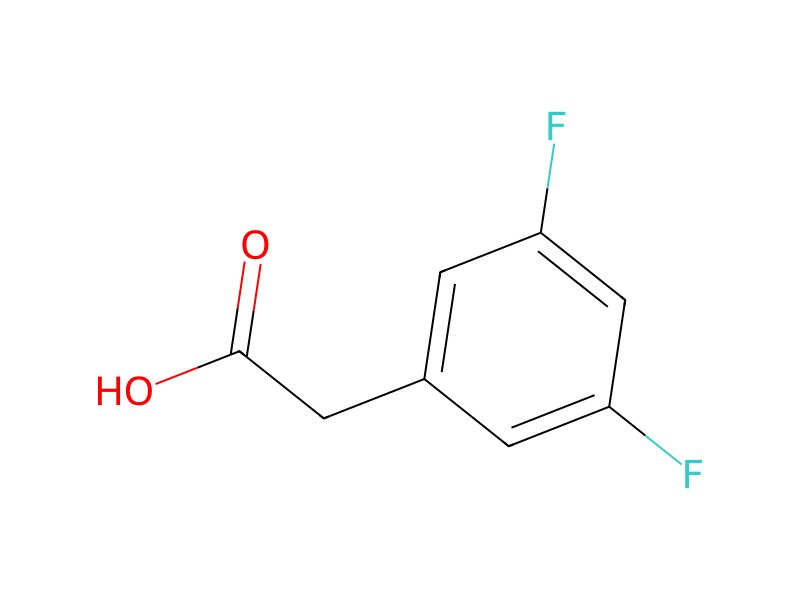
[F:1][C:2]1[CH:3]=[C:4]([CH2:9][C:10]([OH:12])=O)[CH:5]=[C:6]([F:8])[CH:7]=1.S(Cl)([Cl:15])=O>>[F:1][C:2]1[CH:3]=[C:4]([CH2:9][C:10]([Cl:15])=[O:12])[CH:5]=[C:6]([F:8])[CH:7]=1Participants


Procedure
A mixture 3,5-difluorophenylacetic acid (100 g, 0.58 mmol) and thionyl chloride (13.7M, 100 mL, 1.37 mol) was stirred for 15 hours at room temperature. Evaporation gave 3,5-difluorophenylacetyl chloride as an oily residue. A stirred suspension of aluminum chloride (154 g, 1.16 mmol) in 1 L of methylene chloride was cooled to -65° C. and the acid chloride in 200 mL of methylene chloride was added dropwise such that the reaction temperature did not exceed -60° C. Ethylene gas was bubbled through the suspension at a rapid rate for 10 minutes at -65° C. The reaction mixture was allowed to warm to 0° C. over 2 hours, then cooled to -10° C. and treated with 500 mL of water. The organic layer was separated, washed with 100 mL of aqueous sodium chloride, and then dried over magnesium sulfate. The mixture was filtered and the filtrate was concentrated under reduced pressure. Distillation of the residue in vacuo (bp 90°-110° C. [1.0 to 0.7 mm]) gave a clear distillate. Redistillation (bp 100°-105° C. [0.3 mm]) gave 5,7-difluoro-1,2,3,4-tetrahydronaphthalen-2-one (73.56 g, 0.342 mol) as a white solid, m.p. 46° C.
Workup
- customEvaporation
Sources & evidence
- ORD record
- ord-75e0fcccb50d45959f8dc8eaa1fdd220
- Source dataset
- uspto-grants-1998_02
- Patent number
- US05719280
Reaction notes
Loading…