Sodium Acetate → Dimethyl (2-aminopurin-9-ylmethyl)succinate
Reaction equation

[NH2:1][C:2]1[N:10]=[C:9]2[C:5]([N:6]=[CH:7][N:8]2[CH2:11][CH:12]([CH2:17][C:18]([O:20][CH3:21])=[O:19])[C:13]([O:15][CH3:16])=[O:14])=[C:4](Cl)[N:3]=1.C([O-])(=O)C.[Na+]>[Pd].C(O)C>[NH2:1][C:2]1[N:10]=[C:9]2[C:5]([N:6]=[CH:7][N:8]2[CH2:11][CH:12]([CH2:17][C:18]([O:20][CH3:21])=[O:19])[C:13]([O:15][CH3:16])=[O:14])=[CH:4][N:3]=1Participants
5
Reactant 2

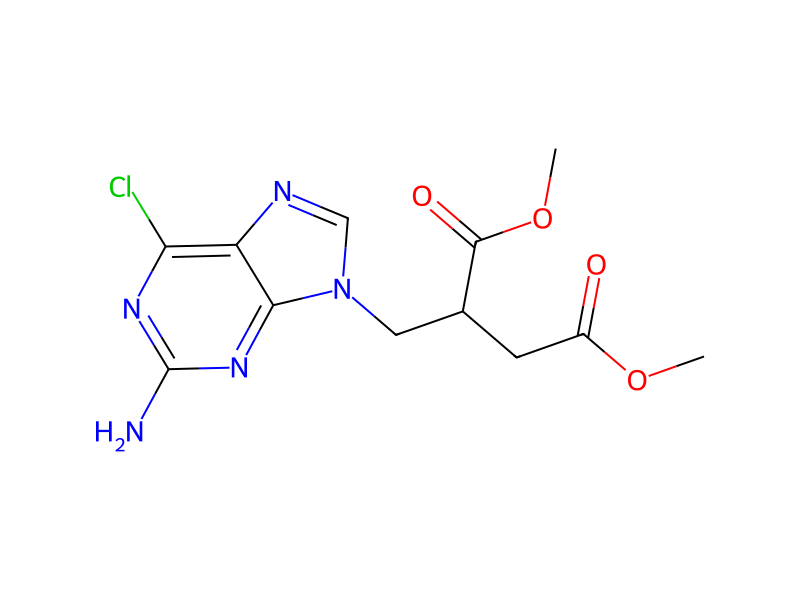
Product 1

Reagents, catalysts & solvents 2


Procedure
A mixture of dimethyl 2-(2-amino-6-chloropurin-9-ylmethyl)succinate (3.28 g, 10 mmol), sodium acetate (1.5 g) and 5% palladium on charcoal (0.4 g) in ethanol (200 ml) was hydrogenated with agitation in a Parr apparatus at 40 psi for 115 h/room temperature. After filtration, sodium acetate (1.6 g) and 5% Pd/C (0.4 g) were added and the hydrogenation was continued for 70 h. After filtration and evaporation to dryness, the residue was extracted with 2×50 ml of chloroform and the combined extracts were evaporated to dryness affording 2.6 g (89%) of crude dechlorinated product.
Workup
- customroom temperature
- filtrationAfter filtration, sodium acetate (1.6 g) and 5% Pd/C (0.4 g)
- additionwere added
- waitthe hydrogenation was continued for 70 h
- filtrationAfter filtration and evaporation to dryness
- extractionthe residue was extracted with 2×50 ml of chloroform
- customthe combined extracts were evaporated to dryness
- customaffording 2.6 g (89%) of crude dechlorinated product
Sources & evidence
- ORD record
- ord-b809c9212ff0407a8ffbcd7f9257d83c
- Source dataset
- uspto-grants-1996_10
- Patent number
- US05565461
Reaction notes
Loading…