Acetone → HCID 86734812, compound
Reaction equation
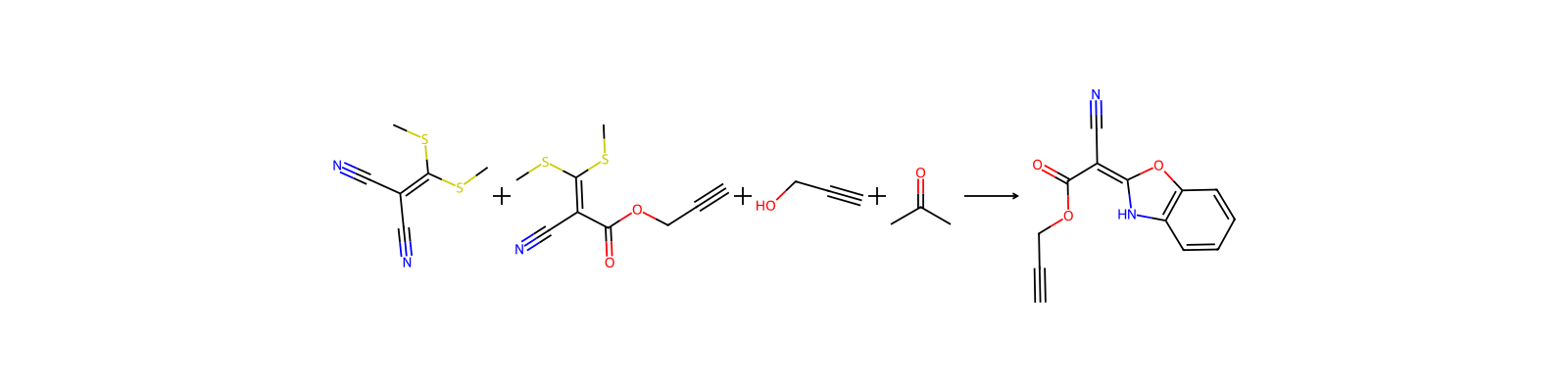
CSC(SC)=[C:4]([C:7]#[N:8])[C:5]#N.[CH2:11]([O:14][C:15](=[O:24])[C:16]([C:22]#[N:23])=[C:17](SC)SC)[C:12]#[CH:13].[CH2:25](O)[C:26]#[CH:27].CC(C)=[O:31]>>[CH2:11]([O:14][C:15](=[O:24])[C:16]([C:22]#[N:23])=[C:17]1[NH:8][C:7]2[CH:25]=[CH:26][CH:27]=[CH:5][C:4]=2[O:31]1)[C:12]#[CH:13]Participants
5



Procedure
The procedure described in Example 1 is repeated using, instead of 3,3-bis(methylthio)-2-cyanoacrylonitrile, an equivalent amount of 3,3-bis(methylthio)-2-cyanoacrylic acid propargyl ester in 100 ml. of propargyl alcohol and holding the mixture under reflux for 2 hours to obtain 2-benzoxazolinylidene-cyanoacetic acid propargyl ester of melting point 258°-259° C. (decomposition) (from acetone).
Workup
- temperatureunder reflux for 2 hours
Sources & evidence
- ORD record
- ord-a34c3f857a1e43f4a1a7bdecb6757928
- Source dataset
- uspto-grants-1978_07
- Patent number
- US04098598
Reaction notes
Loading…