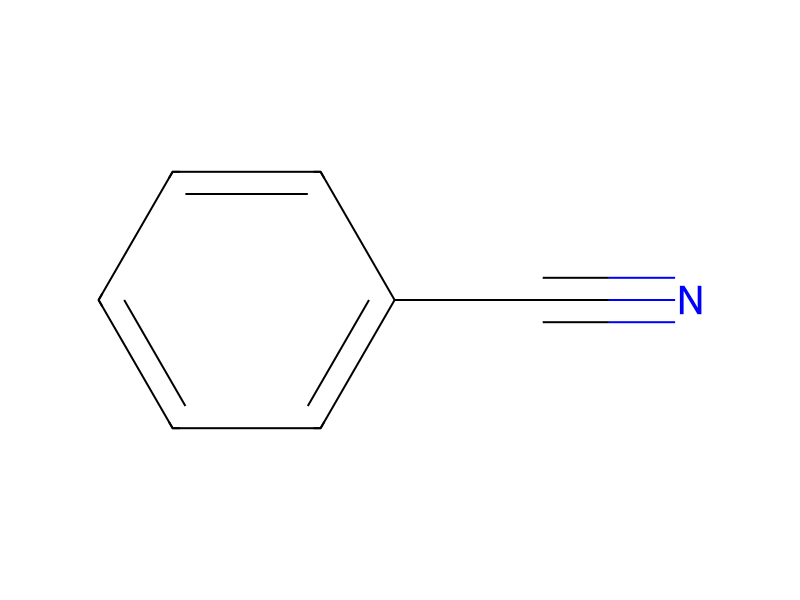
Benzonitrile → [(benzylamino)-phenylmethyl]phosphonic acid
Reaction equation

[C:1](#[N:8])[C:2]1[CH:7]=[CH:6][CH:5]=[CH:4][CH:3]=1.[P:9]([O-:16])([O:13]CC)[O:10]CC.[H][H]>[Ni]>[CH2:1]([NH:8][CH:1]([P:9](=[O:10])([OH:13])[OH:16])[C:2]1[CH:7]=[CH:6][CH:5]=[CH:4][CH:3]=1)[C:2]1[CH:7]=[CH:6][CH:5]=[CH:4][CH:3]=1Participants
Reactant 3


Product 1

Reagents, catalysts & solvents 1

Conditions
- Temperature
- 60 °C
Procedure
To a solution of benzonitrile (75g; 0.73 mole) in diethyl phosphite (200g; 1.45 mole) was added W-2 Raney nickel (6g) and the whole mixture charged in an autoclave. The reactor was pressured to 600 psi with hydrogen and the mixture heated to 60° C. The pressure was maintained at 550-600 psi by addition of hydrogen as the reduction proceeded. After 18 hours, uptake of hydrogen had ceased. After cooling hydrogen was released and the catalyst filtered as the reaction product was removed from the reactor. Excess diethyl phosphite and unreacted benzonitrile was removed (135g) by distillation under reduced pressure. The residue was diethyl N-benzylα-aminobenzylphosphonate. Hydrolysis of this residue with 18% HCl after crystallization yielded N-benzylα-amino benzylphosphonic acid, 83g (82%), mp 233°-6°. ##STR9##
Workup
- additionthe whole mixture charged in an autoclave
- filtrationthe catalyst filtered as the reaction product
- customwas removed from the reactor
- customExcess diethyl phosphite and unreacted benzonitrile was removed (135g)
- distillationby distillation under reduced pressure
- customHydrolysis of this residue with 18% HCl
- customafter crystallization
Sources & evidence
- ORD record
- ord-b91e18bd9fce42d38fa775d835135030
- Source dataset
- uspto-grants-1978_07
- Patent number
- US04098849
Reaction notes
Loading…