2-Ethylbutyraldehyde → 4-Ethyl-4-formylhexanenitrile
Reaction equation

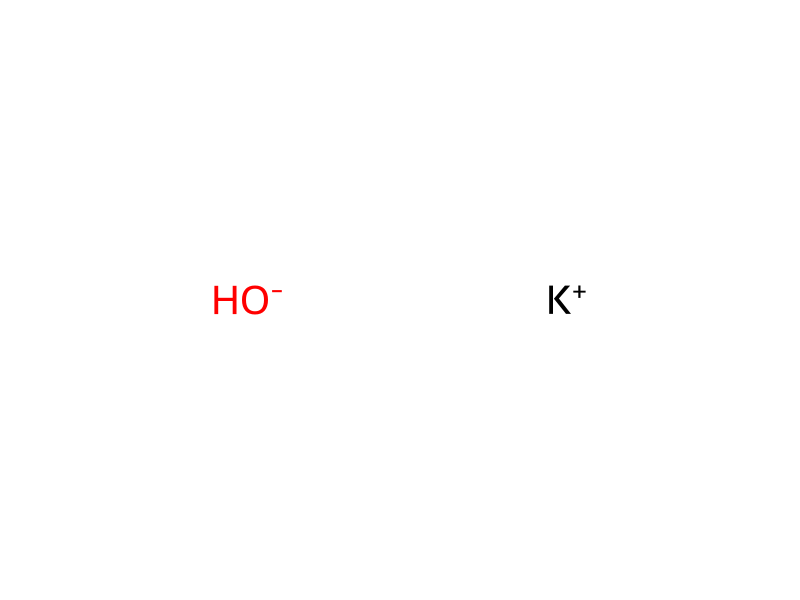
[CH2:1]([CH:3]([CH2:6][CH3:7])[CH:4]=[O:5])[CH3:2].[C:8](#[N:11])[CH:9]=[CH2:10].[OH-].[K+]>>[C:8]([CH2:9][CH2:10][C:3]([CH2:6][CH3:7])([CH2:1][CH3:2])[CH:4]=[O:5])#[N:11]Participants



Procedure
In the presence of alkaline catalysts, acrylonitrile reacts with aldehydes, the α-carbon atoms of which possess one or two hydrogen atoms, forming 3-substituted propionitriles (U.S. Pat. No. 2,353,687). This so-called "cyanoethylation" reaction also occurs with other compounds which have an active hydrogen atom. For example, 2-ethyl butyraldehyde and acrylonitrile react in the presence of catalytic amounts of 50 percent caustic potash solution forming 2-(β-cyanoethyl)-2-ethyl butyraldehyde. A yield of 76.6 percent results after a reaction period of 4.5 hours. (H. A. Bruson, Th. W. Riener, J. Am. Chem. Soc., 66, 57 [1944]). The reaction is strongly exothermal. Acetaldehyde reacts with acrylonitrile in the presence of a 50 percent caustic soda solution forming γ-formylpimelonitrile. For a yield of 40-50%, the reaction period amounts to 2-3 hours. Under the same conditions, propionaldehyde forms 4.9 percent 2-methyl-4-cyanobutyraldehyde (U.S. Pat. No. 2,409,086). 2,2-dimethyl-4-cyano-butyraldehyde is formed in up to 60 percent yield from the reaction between isobutyraldehyde and acrylonitrile.
Workup
- customThis so-called "cyanoethylation" reaction
Sources & evidence
- ORD record
- ord-3bb7ffd0d2b5456fb70f2d7ec0e7e89d
- Source dataset
- uspto-grants-1978_07
- Patent number
- US04102913
Reaction notes
Loading…