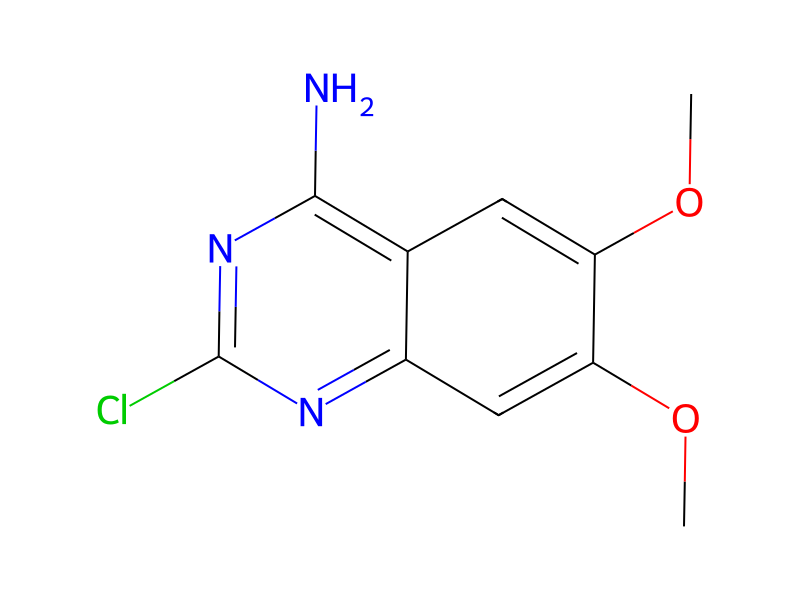
2-Chloro-6,7-dimethoxy-4-quinazolinamine → 95550-22-4
Reaction equation

[CH3:1][O:2][CH2:3][CH2:4][C:5]([N:7]1[CH2:12][CH2:11][NH:10][CH2:9][CH2:8]1)=[O:6].Cl[C:14]1[N:23]=[C:22]([NH2:24])[C:21]2[C:16](=[CH:17][C:18]([O:27][CH3:28])=[C:19]([O:25][CH3:26])[CH:20]=2)[N:15]=1>>[NH2:24][C:22]1[C:21]2[C:16](=[CH:17][C:18]([O:27][CH3:28])=[C:19]([O:25][CH3:26])[CH:20]=2)[N:15]=[C:14]([N:10]2[CH2:9][CH2:8][N:7]([C:5](=[O:6])[CH2:4][CH2:3][O:2][CH3:1])[CH2:12][CH2:11]2)[N:23]=1Participants
3


Procedure
A mixture of 1-(3-methoxypropionyl) piperazine (6.4 g) and 2-chloro-4-amino-6,7-dimethoxyquinazoline (8.9 g) in 100 ml of isoamylalchohol is refluxed with stirring for 6 hours. The reaction mixture is cooled at room temperature for 12 hours. The crystallized product is separated and wet recrystallized by dissolving in warm methanol, with the subsequent addition of ether to the beginning of turbidity. The yield is 13.4 g of the title compound in the form of a hydrochloride monohydrate, which melts at 268°-272° C. with decomposition. Another crystallization from a methanol-ether mixture yields the analytically pure product melting at 273°-278° C. with decomposition.
Workup
- temperatureis refluxed
- customThe crystallized product is separated
- customwet recrystallized
- dissolutionby dissolving in warm methanol, with the subsequent addition of ether to the beginning of turbidity
- customAnother crystallization from a methanol-ether mixture
Sources & evidence
- ORD record
- ord-eb3255d3435c4170859474d863f1e808
- Source dataset
- uspto-grants-1988_10
- Patent number
- US04775673
Reaction notes
Loading…