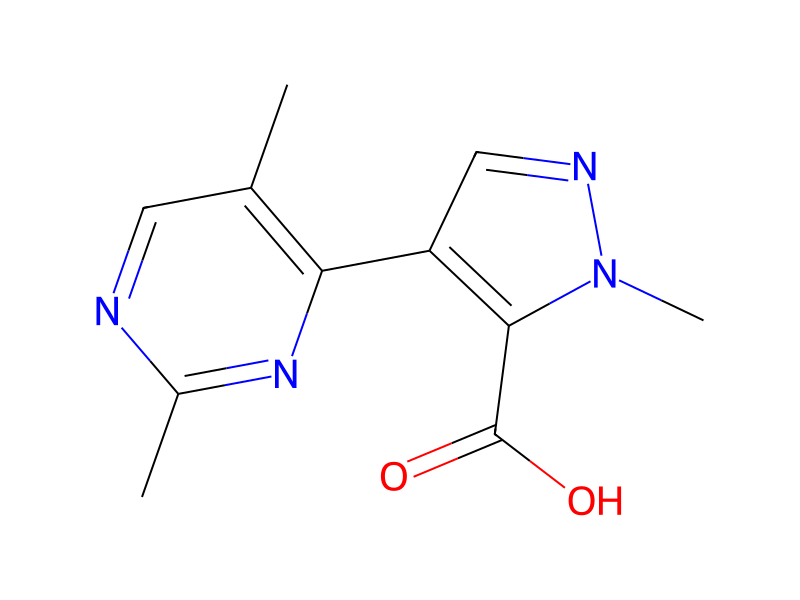
Methanol → 4-(2,5-dimethylpyrimidin-4-yl)-1-methyl-1H-pyrazole-5-carboxylic acid
Reaction equation

[OH-].[Na+].CO.[CH3:5][C:6]1[N:11]=[C:10]([C:12]2[CH:13]=[N:14][N:15]([CH3:21])[C:16]=2[C:17]([O:19]C)=[O:18])[C:9]([CH3:22])=[CH:8][N:7]=1>O>[CH3:5][C:6]1[N:11]=[C:10]([C:12]2[CH:13]=[N:14][N:15]([CH3:21])[C:16]=2[C:17]([OH:19])=[O:18])[C:9]([CH3:22])=[CH:8][N:7]=1Participants
5




Conditions
- Temperature
- 50 °C
Procedure
Sodium hydroxide (0.31 g) was added to a mixed solution of methanol (15 ml) and water (15 ml) containing the methyl 4-(2,5-dimethylpyrimidin-4-yl)-1-methyl-1H-pyrazole-5-carboxylate (1.9 g) obtained in (Example 3.22) <Step 1>, and the obtained mixture was then stirred at 50° C. for 1 hour. Thereafter, methanol was distilled away from the reaction solution under reduced pressure, and the residue was then adjusted to pH 5-6 by addition of 1 N hydrochloric acid. Thereafter, water was distilled away under reduced pressure. The obtained residue was washed with methylene chloride, and the filtrate was then concentrated under reduced pressure, so as to obtain the title compound (0.94 g) in the form of a yellow solid.
Workup
- customobtained in (Example 3.22) <Step 1>
- distillationThereafter, methanol was distilled away from the reaction solution under reduced pressure
- additionthe residue was then adjusted to pH 5-6 by addition of 1 N hydrochloric acid
- distillationThereafter, water was distilled away under reduced pressure
- washThe obtained residue was washed with methylene chloride
- concentrationthe filtrate was then concentrated under reduced pressure
Sources & evidence
- ORD record
- ord-886331624abc4c2d823e3de60c6b6614
- Source dataset
- uspto-grants-2015_03
- Patent number
- US08980888B2
Reaction notes
Loading…