Sodium borohydride → (2-Chloro-4-morpholinothieno[3,2-d]pyrimidin-6-yl)methanol
Reaction equation

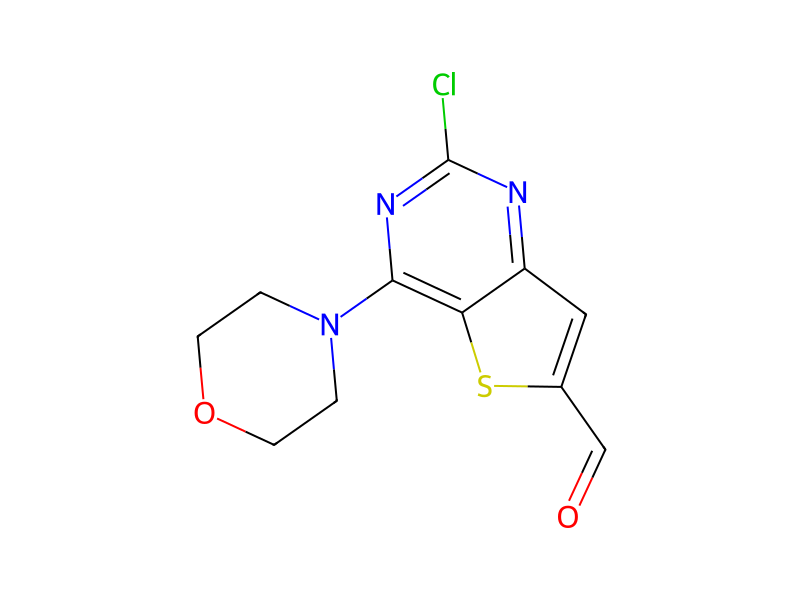
[Cl:1][C:2]1[N:3]=[C:4]([N:13]2[CH2:18][CH2:17][O:16][CH2:15][CH2:14]2)[C:5]2[S:10][C:9]([CH:11]=[O:12])=[CH:8][C:6]=2[N:7]=1.[BH4-].[Na+]>C(O)C>[Cl:1][C:2]1[N:3]=[C:4]([N:13]2[CH2:14][CH2:15][O:16][CH2:17][CH2:18]2)[C:5]2[S:10][C:9]([CH2:11][OH:12])=[CH:8][C:6]=2[N:7]=1Participants
4
Reactant 2

Product 1

Reagents, catalysts & solvents 1

Procedure
To 2-chloro-4-morpholin-4-yl-thieno[3,2-d]pyrimidine-6-carbaldehyde 10 (1.5 g) in ethanol (30 mL) was added sodium borohydride (1 g). After 4 hours the reaction mixture was quenched with brine and the resulting solid was collected by filtration and air dried to yield (2-chloro-4-morpholin-4-yl-thieno[3,2-d]pyrimidin-6-yl)-methanol (1.42 g).
Workup
- customAfter 4 hours the reaction mixture was quenched with brine
- filtrationthe resulting solid was collected by filtration and air
- customdried
Sources & evidence
- ORD record
- ord-4de8868399be4caa8727923728cfdff0
- Source dataset
- uspto-grants-2015_03
- Patent number
- US08993563B2
Reaction notes
Loading…