Sodium hydride → ethyl 4-chloro-7-((2-(trimethylsilyl)ethoxy)methyl)-7H-pyrrolo[2,3-d]pyrimidine-5-carboxylate
Reaction equation

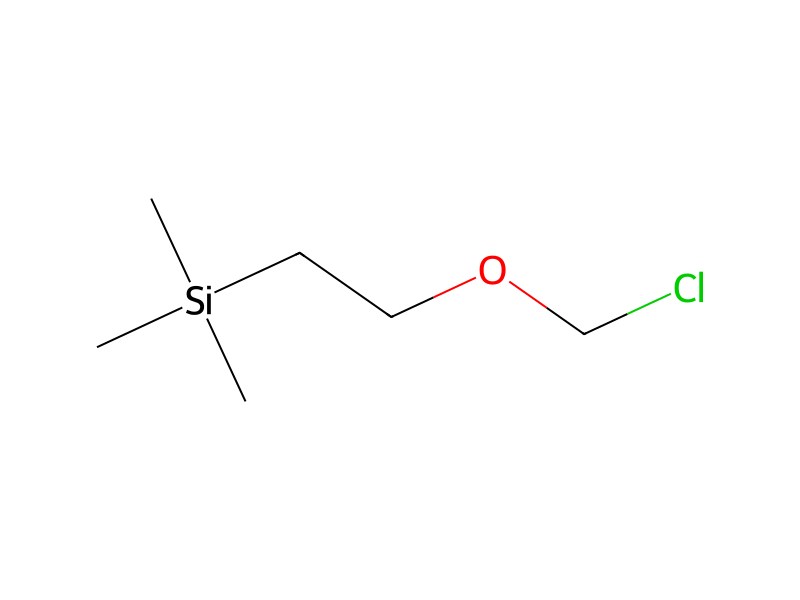
[Cl:1][C:2]1[C:3]2[C:10]([C:11]([O:13][CH2:14][CH3:15])=[O:12])=[CH:9][NH:8][C:4]=2[N:5]=[CH:6][N:7]=1.[CH3:16][Si:17]([CH2:20][CH2:21][O:22][CH2:23]Cl)([CH3:19])[CH3:18].[H-].[Na+]>CN(C=O)C>[CH2:14]([O:13][C:11]([C:10]1[C:3]2[C:2]([Cl:1])=[N:7][CH:6]=[N:5][C:4]=2[N:8]([CH2:23][O:22][CH2:21][CH2:20][Si:17]([CH3:19])([CH3:18])[CH3:16])[CH:9]=1)=[O:12])[CH3:15]Participants
Reactant 3


Product 1

Reagents, catalysts & solvents 1

Conditions
- Temperature
- 0 °C
Procedure
To a stirred mixture of ethyl 4-chloro-7H-pyrrolo[2,3-d]pyrimidine-5-carboxylate (4.00 g, 17.7 mmol) and SEMCl (4.71 mL, 26.6 mmol) in DMF (90 mL) was added sodium hydride (0.851 g, 21.3 mmol) portion-wise at 0° C. The resulting yellow suspension was stirred at 0° C. for one hour and then allowed to warm to room temperature over one hour. The reaction was quenched with water slowly then extracted with ethyl acetate (×3). The combined organic layers were washed with brine (150 mL), dried over sodium sulfate, filtered and concentrated under reduced pressure. The residue was purified by chromatography on silica eluting with 0-50% ethyl acetatehexane to afford ethyl-4-chloro-7-((2-(trimethylsilyl)ethoxy)methyl)-7H-pyrrolo[2,3-d]pyrimidine-5-carboxylate. LRMS (ESI) calc'd for C15H23ClN3O3Si [M+H]+: 356; found 356.
Workup
- temperatureto warm to room temperature over one hour
- customThe reaction was quenched with water slowly
- extractionextracted with ethyl acetate (×3)
- washThe combined organic layers were washed with brine (150 mL)
- dry with materialdried over sodium sulfate
- filtrationfiltered
- concentrationconcentrated under reduced pressure
- customThe residue was purified by chromatography on silica eluting with 0-50% ethyl acetatehexane
Sources & evidence
- ORD record
- ord-9938c19915ec41849fb1bcff487228b6
- Source dataset
- uspto-grants-2015_03
- Patent number
- US08993756B2
Reaction notes
Loading…