Diisopropylethylamine → 1-(7-bromo-4-methoxy-1H-pyrrolo[2,3-c]pyridin-3-yl)-2-(5-(pyridin-2-yl)-3,4-dihydroisoquinolin-2(1H)-yl)ethane-1,2-dione
Reaction equation

[N:1]1[CH:6]=[CH:5][CH:4]=[CH:3][C:2]=1[C:7]1[CH:16]=[CH:15][CH:14]=[C:13]2[C:8]=1[CH2:9][CH2:10][NH:11][CH2:12]2.[Br:17][C:18]1[N:19]=[CH:20][C:21]([O:32][CH3:33])=[C:22]2[C:26]([C:27](=[O:31])[C:28](O)=[O:29])=[CH:25][NH:24][C:23]=12.CCN(C(C)C)C(C)C.[B-](F)(F)(F)F.CN(C(ON1N=NC2C1=CC=CC=2)=[N+](C)C)C>CN(C=O)C>[Br:17][C:18]1[N:19]=[CH:20][C:21]([O:32][CH3:33])=[C:22]2[C:26]([C:27](=[O:31])[C:28]([N:11]3[CH2:10][CH2:9][C:8]4[C:13](=[CH:14][CH:15]=[CH:16][C:7]=4[C:2]4[CH:3]=[CH:4][CH:5]=[CH:6][N:1]=4)[CH2:12]3)=[O:29])=[CH:25][NH:24][C:23]=12Participants
Reactant 4

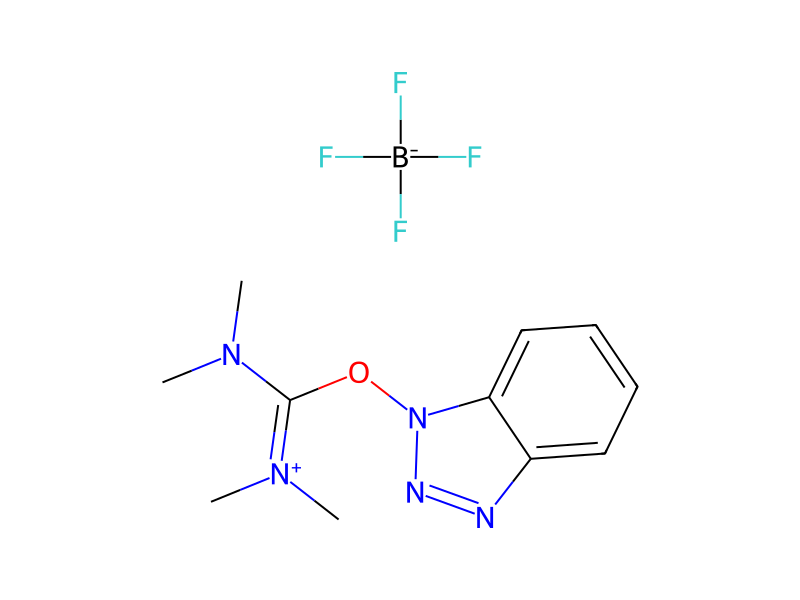


Product 1

Reagents, catalysts & solvents 1

Procedure
To a 250 mL flask was added 5-(pyridin-2-yl)-1,2,3,4-tetrahydroisoquinoline (2.250 g, 10.7 mmol) and 2-(7-bromo-4-methoxy-1H-pyrrolo[2,3-c]pyridin-3-yl)-2-oxoacetic acid (2.75 g, 9.19 mmol). The mixture was diluted with DMF (100 mL) and Hunig's Base (16.6 mL, 95 mmol) and o-benzotriazol-1-yl-N,N,N′,N′-tetramethyluronium tetrafluoroborate (4 g, 12.46 mmol) was added to the mixture. The mixture was stirred at rt for 70 h, quenched with water (50 mL) and the solvent removed under reduced pressure. The residue was diluted with water (100 mL) and extracted with dichloromethane (3×100 mL). The combined organic layers were dried with Na2SO4. The drying agent was removed by filtration and the residue purified by BIOTAGE® flash chromatography using a 0-5% MeOH in dichloromethane gradient. The residue still had impurities by 1H NMR so it was dissolved in dichloromethane (150 mL) and washed with sat. NaHCO3 (100 mL) then with sat. ammonium chloride (150 mL). The organic solution was dried with Na2SO4, the drying agent was removed by filtration, and the solution was concentrated under reduced pressure to give 1-(7-bromo-4-methoxy-1H-pyrrolo[2,3-c]pyridin-3-yl)-2-(5-(pyridin-2-yl)-3,4-dihydroisoquinolin-2(1H)-yl)ethane-1,2-dione (3.40 g, 6.92 mmol, 75% yield) as a blue solid. The product still had some impurities by 1H NMR, but was used in the next step with no additional purification. LC/MS: m/z 489.14 (M+H)+, 1.169 min (method 1). 1H NMR (500 MHz, chloroform-d) δ ppm 10.89 (br. s., 1H) 8.62-8.80 (m, 1H) 7.64-7.95 (m, 3H) 6.98-7.49 (m, 5H) 4.66-4.99 (m, 2H) 3.60-3.87 (m, 5H) 2.87-3.12 (m, 2H).
Workup
- additionwas added to the mixture
- customquenched with water (50 mL)
- customthe solvent removed under reduced pressure
- additionThe residue was diluted with water (100 mL)
- extractionextracted with dichloromethane (3×100 mL)
- dry with materialThe combined organic layers were dried with Na2SO4
- customThe drying agent was removed by filtration
- customthe residue purified by BIOTAGE® flash chromatography
- dissolutionThe residue still had impurities by 1H NMR so it was dissolved in dichloromethane (150 mL)
- washwashed with sat. NaHCO3 (100 mL)
- dry with materialThe organic solution was dried with Na2SO4
- customthe drying agent was removed by filtration
- concentrationthe solution was concentrated under reduced pressure
Sources & evidence
- ORD record
- ord-7bca41c4d0774b7889fafead797e1c3c
- Source dataset
- uspto-grants-2012_08
- Patent number
- US08242124B2
Reaction notes
Loading…