Acetic Acid → 14alpha-Fluoroandrost-4-ene-3, 17-dione
Reaction equation

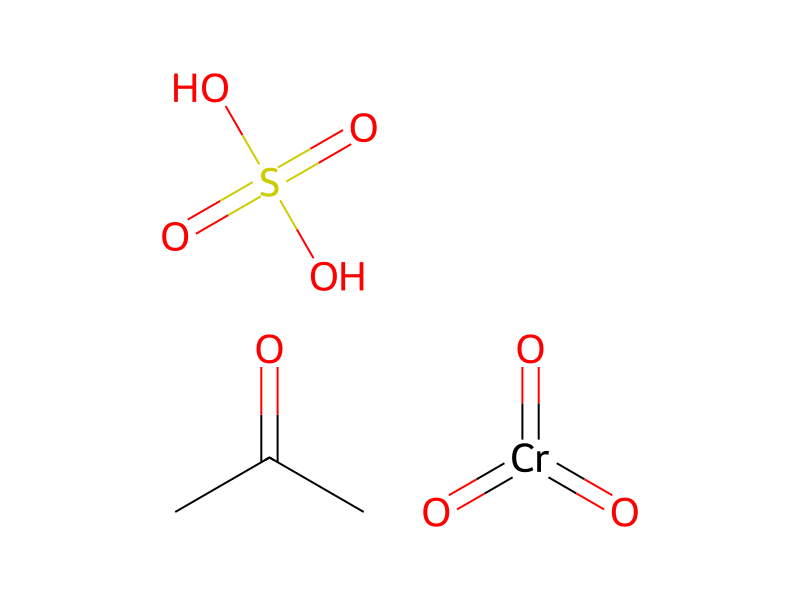
[F:1][C@:2]12[C@H:19]3[C@@H:10]([C@:11]4([CH3:21])[C:16](=[CH:17][CH2:18]3)[CH2:15][C@@H:14]([OH:20])[CH2:13][CH2:12]4)[CH2:9][CH2:8][C@:6]1([CH3:7])[C:5](=[O:22])[CH2:4][CH2:3]2.CC(C)=O.OS(O)(=O)=O.O=[Cr](=O)=O.C(O)(=O)C.O>CC(C)=O>[F:1][C@:2]12[C@H:19]3[C@@H:10]([C@:11]4([CH3:21])[C:16]([CH2:17][CH2:18]3)=[CH:15][C:14](=[O:20])[CH2:13][CH2:12]4)[CH2:9][CH2:8][C@:6]1([CH3:7])[C:5](=[O:22])[CH2:4][CH2:3]2Participants
Reactant 4



Product 1

Reagents, catalysts & solvents 1

Procedure
A solution of 14α-fluoro-3β-hydroxyandrost-5(6)-en-17-one (93 mg), prepared as described in (i) above, in acetone (20 ml) was treated with Jones reagent (0.10 ml) at 0°-5° for 5 min. Excess Jones reagent was destroyed by the addition of isopropanol (0.2 ml) and water (5 ml) was added. The organic solvents were then evaporated off in vacuo and the aqueous residue was extracted with chloroform. The chloroform was evaporated in vacuo and the thus-obtained residue dissolved in warm methanol (10 ml). The resulting solution was treated with one drop of 2 N aqueous sodium hydroxide and warmed on a steam bath for 5 min. The orange solution so obtained was neutralized with acetic acid, water was added, and the organic solvents were evaporated of in vacuo. The residue was extracted with chloroform, and the solution was washed with sodium bicarbonate and water, and then dried. Evaporation of the chloroform in vacuo gave a solid (92 mg) which was chromatographed by p.l.c. (silica gel) eluting with ethyl acetate:hexane (1:1). Recovery of the major band gave the title compound (68 mg), which crystallised from acetone as prisms (58 mg) m.p. 216°-217°; [α]D24 +181° (c 0.69, CHCl3); λmax (ethanol) 239 nm (ε12,900); νmax 1740, 1660 and 1615 cm-1 ; the PMR spectrum included signals at δ1.05 (3H, s, 18-Me), 1.22 (3H, s, 19-Me) and 5.8 (1H, s, 4-H); FMR φ*+164.5 ppm (broad multiplet ca 90 Hz wide). (Found: C, 74.82; H, 8.23; F, 6.30, C19H25O2F requires C,74.97; H,8.28; F,6.24%).
Workup
- customExcess Jones reagent was destroyed by the addition of isopropanol (0.2 ml) and water (5 ml)
- additionwas added
- customThe organic solvents were then evaporated off in vacuo
- extractionthe aqueous residue was extracted with chloroform
- customThe chloroform was evaporated in vacuo
- dissolutionthe thus-obtained residue dissolved in warm methanol (10 ml)
- additionThe resulting solution was treated with one drop of 2 N aqueous sodium hydroxide
- temperaturewarmed on a steam bath for 5 min
- customThe orange solution so obtained
- additionwas added
- customthe organic solvents were evaporated of in vacuo
- extractionThe residue was extracted with chloroform
- washthe solution was washed with sodium bicarbonate and water
- customdried
- customEvaporation of the chloroform in vacuo
Sources & evidence
- ORD record
- ord-9dea5859f801496c93a9666c477cc8fd
- Source dataset
- uspto-grants-1981_08
- Patent number
- US04284558
Reaction notes
Loading…