4-Amino-6-chloro-2-methylthiopyrimidine → 4-Chloro-2-(methylthio)-6-(1H-pyrrol-1-yl)pyrimidine
Reaction equation

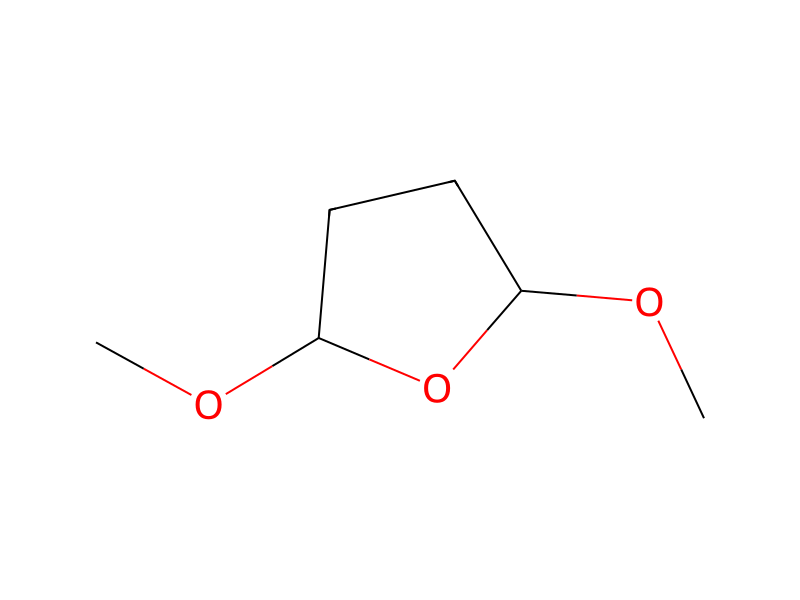
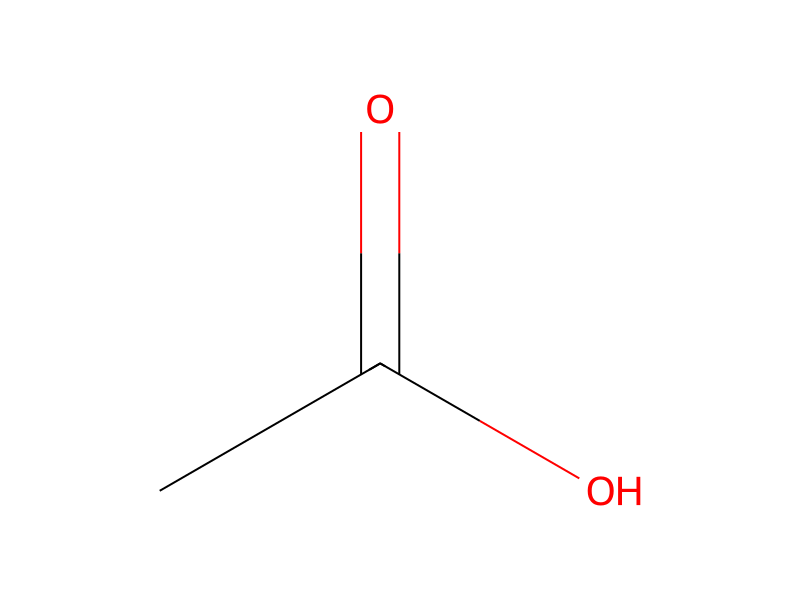
[NH2:1][C:2]1[CH:7]=[C:6]([Cl:8])[N:5]=[C:4]([S:9][CH3:10])[N:3]=1.CO[CH:13]1[CH2:17][CH2:16][CH:15](OC)O1>C(O)(=O)C>[Cl:8][C:6]1[N:5]=[C:4]([S:9][CH3:10])[N:3]=[C:2]([N:1]2[CH:13]=[CH:17][CH:16]=[CH:15]2)[CH:7]=1Participants
Reactant 2

Product 1

Reagents, catalysts & solvents 1
Procedure
As described above, both the dichloro and the difluoro-intermediates provide mixtures of regioisomers when reacted with nucleophiles (cf. 144 in Scheme 19). Although this is useful when both regioisomers are desired, the route shown in Scheme 20 below provides a regioselective synthesis. According to Scheme 20, 4-amino-6-chloro-2-methylthiopyrimidine 151 was reacted with 1 equivalent of 2,5-dimethoxytetrahydrofuran in refluxing acetic acid to provide 6-chloro-2-methylthio-4-(1-pyrrolyl)pyrimidine 152: 1H NMR (CDCl3) δ 2.75 (s,3H), 6.55 (d,2H), 7.05 (s,1H), 7.65 (d,2H). The 6-chloro-2-methylthio-4-(1-pyrrolyl)pyrimidine 152 is either (a) oxidized with 2.2 equivalents of m-chloroperoxybenzoic acid in dichloromethane at 0° C. to provide 6-chloro-2-methylsulfonyl-4-(1-pyrrolyl)pyrimidine 153 or (b) reacted with 1 equivalent of the N-(p-cyanobenzyl)amide of cyclohexylalanine and 1 equivalent of diisopropylethylamine in DMF at 80° C. to provide the 2-methylthiopyrimidine 154. The oxidation and nucleophilic displacement steps are then reversed [i.e. 153 is reacted according to (b) or 154 is reacted according to (a)] to provide the 2-methylsulfonylpyrimidine 155, which is dissolved in n-butanol saturated with ethylamine and heated in a sealed tube to produce 156.
Workup
- customreacted with nucleophiles (cf. 144 in Scheme 19)
- custombelow provides
- customa regioselective synthesis
Sources & evidence
- ORD record
- ord-c9b6f1d4bc28407e8b1cec0fe4992949
- Source dataset
- uspto-grants-2005_07
- Patent number
- US06919347B2
Reaction notes
Loading…