HuagongsheHuagongshe Chemistry Print Report · For research reference only
HRID 902011Generated: October 26, 2026
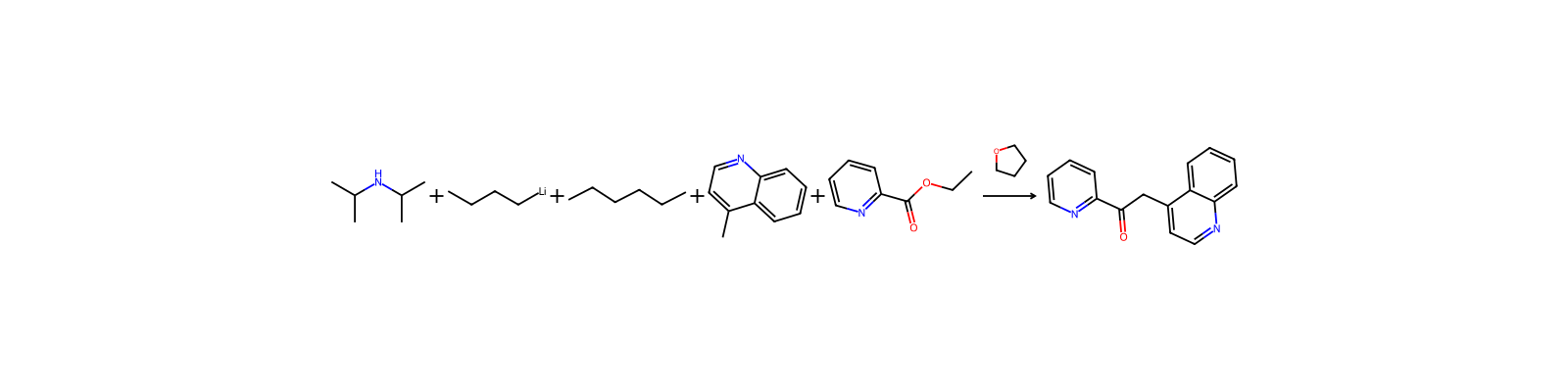
Diisopropylamine → 1-(Pyridin-2-yl)-2-(quinolin-4-yl)ethanone
https://huagongshe.com/reaction/902011
Participants
| Role | Name | HCID | Charge |
|---|
| Reactant | Diisopropylamine | HCID 7912 | — |
| Reactant | Hexane | HCID 8058 | — |
| Reactant | 4-Methylquinoline | HCID 10285 | — |
| Reactant | Ethyl 2-pyridinecarboxylate | HCID 17307 | — |
| Reactant | Butyllithium | HCID 178418339 | — |
| Solvent | Tetrahydrofuran | HCID 8028 | — |
| Product | 1-(Pyridin-2-yl)-2-(quinolin-4-yl)ethanone | HCID 10933856 | 48.3% |
Reaction Steps
To a solution of diisopropylamine (44.9 mL, 320 mmol) in THF (500 mL) at −78° C. add 1.6 M n-butyl lithium in hexane (200 mL, 320 mmol). Stir for 10 minutes and add dropwise a solution of lepidine (42.9 g, 300 mmol) in THF (200 mL) over 20 minutes at −78° C. and quickly add a solution of ethyl picolinate (48.3 g, 320 mmol). Allow the reaction to warm slowly to 0° C. and quench by pouring into water (1 L). Add ethyl acetate (1 L). Dissolve residual solids by adding Acetic acid (20 mL). Separate the layers and extract the aqueous layer with one portion of ethyl acetate (100 mL). Combine the organic extracts, dry over sodium sulfate, and concentrate in vacuo. Triturate the crude oil with hexane/ether to give 36 g of the title compound. Concentrate the filtrate. Chromatograph the residue on silica gel (elute with 10:9:1 CH2Cl2, ether, MeOH). Precipitate the purified product from ether/hexane to give 21 g of the title compound. Combined yield: 57 g (76%) of title compound as a yellow crystalline solid. MS ES+ m/e 249.0 (M+1).
Provenance & Evidence
| DOI | 10.6084/m9.figshare.5104873.v1 |
|---|
| Patent number | US07365066B2 |
|---|
| Source dataset | uspto-grants-2008_04 |
|---|
| ORD ID | ord-7a23bb77d33641979964b223fc55a312 |
|---|
| Source note | uspto-grants-2008_04 |
|---|