Trisodium citrate → HCID 131726842, compound
Reaction equation

[C:1]([O-:13])(=[O:12])[CH2:2][C:3]([CH2:8][C:9]([O-:11])=[O:10])([C:5]([O-:7])=[O:6])[OH:4].[Na+:14].[Na+].[Na+].[OH-].[Na+].[CH2:19]([CH:21]1[O:23][CH2:22]1)[Cl:20]>O>[CH2:19]([CH:21]1[O:23][CH2:22]1)[Cl:20].[C:1]([O-:13])(=[O:12])[CH2:2][C:3]([CH2:8][C:9]([O-:11])=[O:10])([C:5]([O-:7])=[O:6])[OH:4].[Na+:14].[Na+:14].[Na+:14]Participants
5
Reactant 3
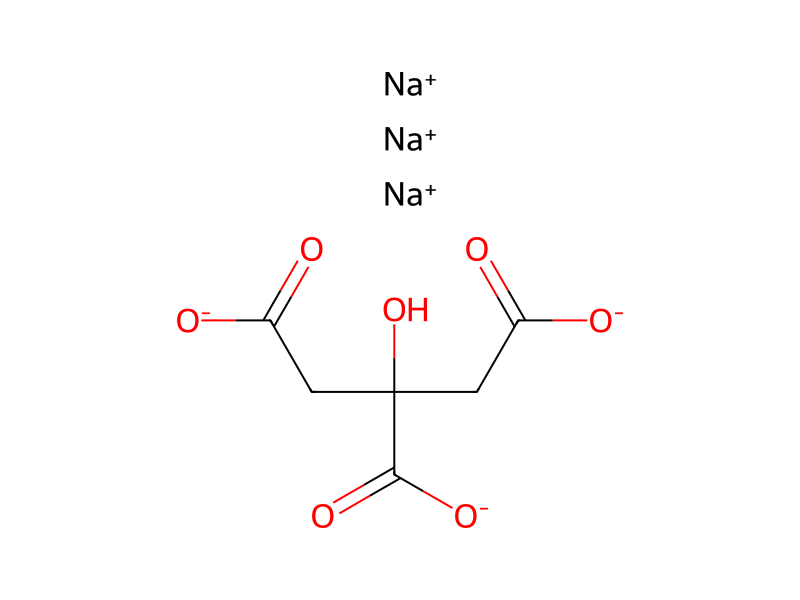


Product 1

Reagents, catalysts & solvents 1

Procedure
Trisodium citrate (7.23 g, 24.6 mmol) was dissolved in 3.3 ml 30% NaOH (1.0 eq.) and epichlorohydrin (1.92 ml, 24.6 mmol) was added. The heterogeneous reaction mixture was stirred at room temperature for 16 hours to give an homogeneous solution which was completed to 20 ml with deionized water. Samples of this stock solution were used without further purification. For the same reason discussed in example 22, we expect the presence of the epoxide group in the adduct.
Workup
- customto give an homogeneous solution which
- customSamples of this stock solution were used without further purification
Sources & evidence
- ORD record
- ord-80ab6d84905f4ac9b05f905caa338a73
- Source dataset
- uspto-grants-2008_04
- Patent number
- US07365190B2
Reaction notes
Loading…