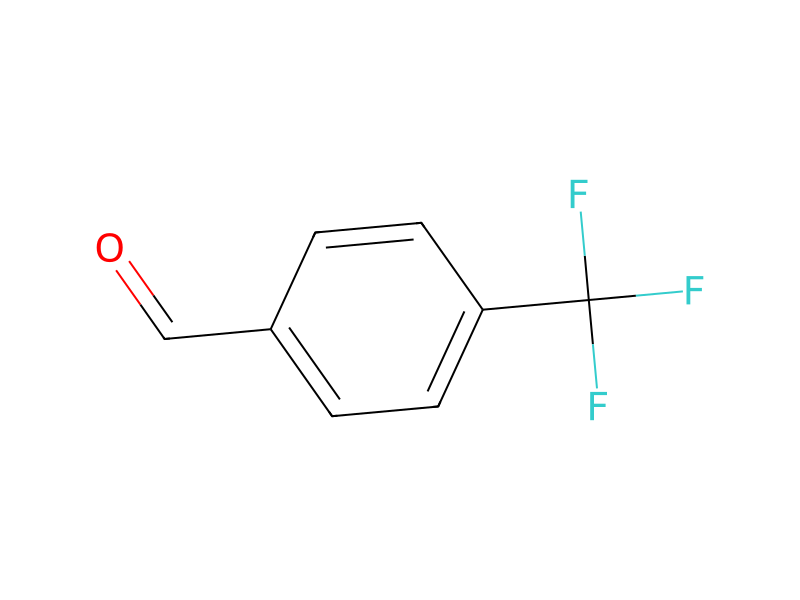
4-(Trifluoromethyl)benzoyl chloride → 4-(Trifluoromethyl)benzaldehyde
Reaction equation

[F:1][C:2]([F:13])([F:12])[C:3]1[CH:11]=[CH:10][C:6]([C:7](Cl)=[O:8])=[CH:5][CH:4]=1.[H][H].[C]=O>C1(C)C=CC=CC=1.[Pd].[C]>[F:1][C:2]([F:12])([F:13])[C:3]1[CH:11]=[CH:10][C:6]([CH:7]=[O:8])=[CH:5][CH:4]=1Participants
6





Procedure
In an apparatus as in Example 2, 100 g of 4-trifluoromethylbenzoyl chloride which had been prepared analogously to Example 1 were hydrogenated in the course of 4 hours at 90° C. in 700 ml of dry toluene with the aid of 3.5 g of Pd-carbon (Pd content: 5% by weight); the conversion was 95%. The Pd-carbon catalyst had been exposed, before the hydrogenation, for 30 minutes in toluene at the boil to a mixture containing 50% by volume each of hydrogen and carbon monoxide. By distillation it was possible to obtain 69.2 g of 4-trifluoromethylbenzaldehyde which had a boiling point of 70°-71° C./20 mbars and an nD20 of 1.4639. Yield: 83% of theory.
Workup
- distillationBy distillation it
Sources & evidence
- ORD record
- ord-97914393e7794d0a9de5102e56574059
- Source dataset
- uspto-grants-1983_12
- Patent number
- US04420433
Reaction notes
Loading…