Phosphoric Acid → 3-Chlorophthalic acid
反応式

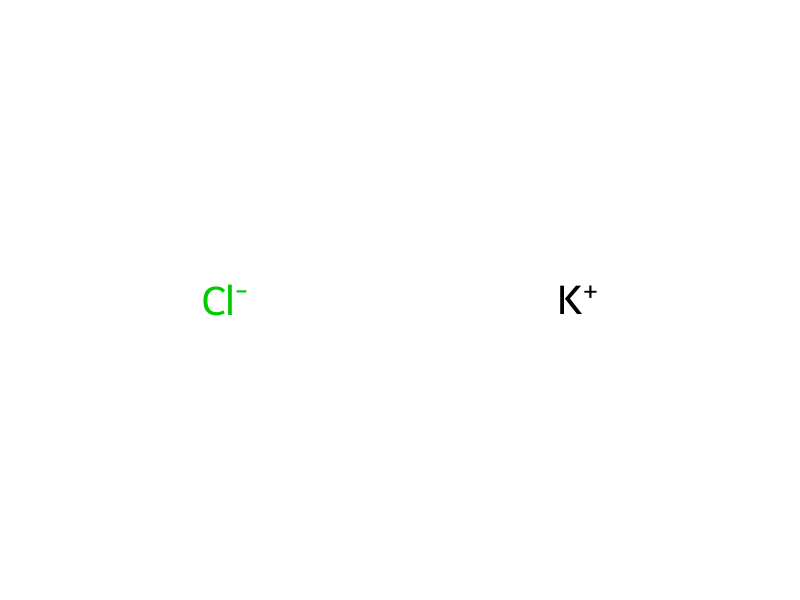
C1C([O:7]C2C=CC3C(OC(=O)C=3C=2)=O)=CC2C(OC(=O)C=2C=1)=O.[Cl-].[K+].[Cl-].C(N(CC)C(=[N+](CC)CC)N(CC)CC)C.[Cl:43][C:44]1[CH:54]=[CH:53][CH:52]=[C:46]2[C:47]([O:49][C:50](=[O:51])[C:45]=12)=[O:48].P(=O)(O)(O)O>O.ClC1C=CC=CC=1Cl>[Cl:43][C:44]1[CH:54]=[CH:53][CH:52]=[C:46]([C:47]([OH:7])=[O:48])[C:45]=1[C:50]([OH:49])=[O:51]参加物
反応物 5



生成物 1

試薬・触媒・溶媒 2

実験手順
The purpose of Example 3 was also to show that without decantation, a relatively higher level of impurities levels were present in the 4,4′ oxydiphthalic anhydride that was produced, as compared to Examples 4 and 5 where decantation is practiced. 2005 parts of a WC of material consisting of 70 wt % 4,4′-oxydiphthalic anhydride, 14 wt % of potassium chloride, 16 wt % of ortho-dichlorobenzene based on total weight of the WC, and some minor impurities as hexaethylguanidinium chloride (1096 ppm) and chlorophthalic anhydride (1637 ppm), was mixed with 437 parts of phosphoric acid (85 wt %) and 12983 parts of water and heated under vacuum until boiling, around 80° C., to form 4,4′-oxydiphthalic tetraacid (ODTA) and chlorophthalic acid (CIDA). The oDCB was removed by azeotrope with water. The weight of the reactor was maintained constant by adding the corresponding amount of water back to the reactor. The process took approximately 34 hours. Subsequently, the mixture was cooled to 22° C. and centrifuged, washing the WC with 10 parts of water per part of 4,4′-oxydiphthalic tetraacid. 1328 parts of the final WC was obtained which contained 86 wt % of 4,4′-oxydiphthalic tetraacid based on total weight of the WC, and less than 30 ppm of hexaethylguanidinium chloride, 724 ppm of chlorophthalic acid, 63 ppm of potassium and the balance (˜14 wt %) was water. The substantially pure 4,4′-oxydiphthalic anhydride produced had a sufficiently high purity for use in commercial applications.
後処理
- customwas produced
- temperatureheated under vacuum
- customuntil boiling, around 80° C.
出典と根拠
- ORDレコード
- ord-33be965e35af42918efd1325bab27fa1
- 出典データセット
- uspto-grants-2011_09
- 特許番号
- US08013173B2
反応ノート
読み込み中…