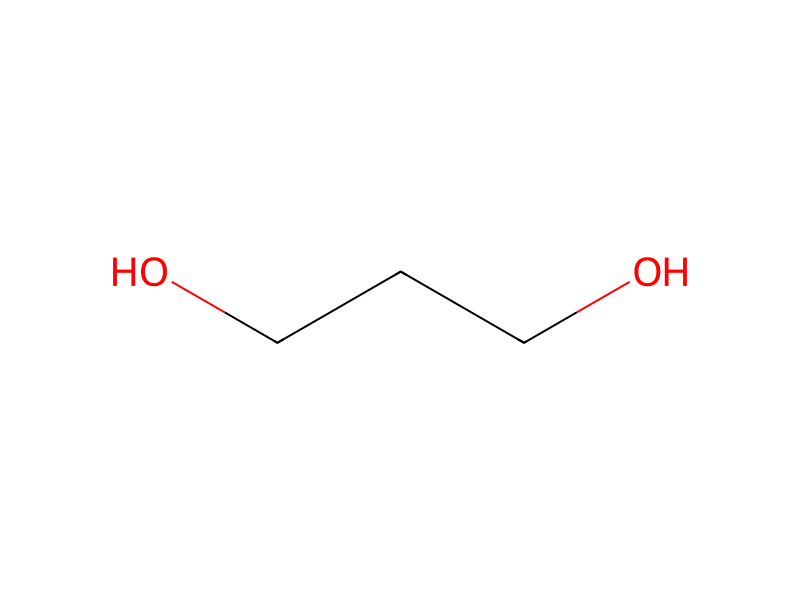
1,3-Propanediol → HCID 23150766, compound
Reaction equation

Br[CH2:2]/[CH:3]=[CH:4]/[C:5]1[CH:14]=[CH:13][C:8]2[O:9][CH2:10][CH2:11][O:12][C:7]=2[CH:6]=1.BrC(C1C=CC2OCCOC=2C=1)C=C.[OH-].[K+].[CH2:31]([OH:35])[CH2:32][CH2:33][OH:34]>CS(C)=O>[OH:34][CH2:33][CH2:32][CH2:31][O:35][CH2:2]/[CH:3]=[CH:4]/[C:5]1[CH:14]=[CH:13][C:8]2[O:9][CH2:10][CH2:11][O:12][C:7]=2[CH:6]=1Participants
6
Reactant 4



Product 1

Reagents, catalysts & solvents 1

Procedure
Following the procedure described in example 7§D, but starting from a mixture of trans-2,3-dihydro-6-(3-bromoprop-1-en-1-yl)benzo[1,4]dioxine and 2,3-dihydro-6-(1-bromoallyl)benzo[1,4]dioxine (650 mg), 296 mg of potassium hydroxide (296 mg 85% wt) and 1,3-propanediol (298 μL) in dimethylsulfoxide (1.8 mL) gives 280 mg of trans-2,3-dihydro-6-[3-(3-hydroxypropoxy)prop-1-en-1-yl]benzo[1,4]dioxine as a yellow oil used without further purification.
Sources & evidence
- ORD record
- ord-df3a507238ca4d1d8246a1bb5bedc42b
- Source dataset
- uspto-grants-2011_09
- Patent number
- US08017646B2
Reaction notes
Loading…