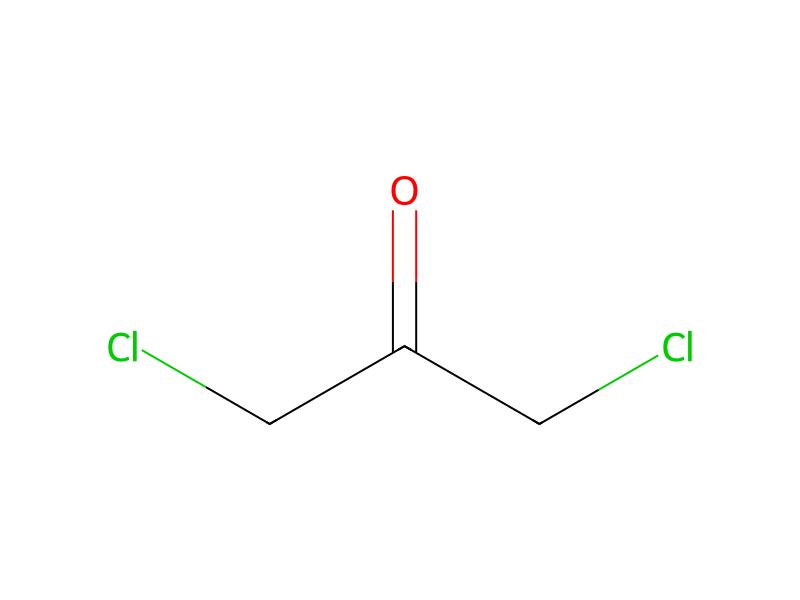
1,3-Dichloroacetone → HCID 45792522, compound
Reaction equation

[F:1][C:2]([F:13])([F:12])[C:3]1[CH:4]=[C:5]([CH:9]=[CH:10][CH:11]=1)[C:6]([NH2:8])=[O:7].[Cl:14][CH2:15][C:16](=O)[CH2:17]Cl>>[Cl:14][CH2:15][C:16]1[N:8]=[C:6]([C:5]2[CH:9]=[CH:10][CH:11]=[C:3]([C:2]([F:12])([F:13])[F:1])[CH:4]=2)[O:7][CH:17]=1Participants
3


Conditions
- Temperature
- 130 °C
Procedure
3-(Trifluoromethyl)benzamide (0.300 g, 1.59 mmol) and 1,3-dichloro-2-propanone (0.201 g, 1.59 mmol) were heated to 130° C. for 0.5 h. Then another 0.201 g of 1,3-dichloro-2-propanone (1.59 mmol) was added and the mixture was heated again at 130° C. for 1 h. After being cooled down, the residue was purified by radial chromatography (0-30% EtOAc-hexanes gradient) to afford the title compound (0.280 g, 67% yield): 1H NMR (400 MHz, CDCl3) δ 8.31 (s, 1H), 8.22 (d, J=7.9 Hz, 1H), 7.75 (s, 1H), 7.72 (d, J=7.9 Hz, 1H), 7.60 (t, J=7.9 Hz, 1H), 4.58 (s, 2H).
Workup
- temperatureAfter being cooled down
- customthe residue was purified by radial chromatography (0-30% EtOAc-hexanes gradient)
Sources & evidence
- ORD record
- ord-30522552cfd3458cb96e5ba3dd0957d2
- Source dataset
- uspto-grants-2011_09
- Patent number
- US08026262B2
Reaction notes
Loading…