Acetyl chloride → 1-{4-Methyl-3-[methyl-(7H-pyrrolo[2,3-d]pyrimidin-4-yl)-amino]-piperidin-1-yl}-ethanone
Reaction equation
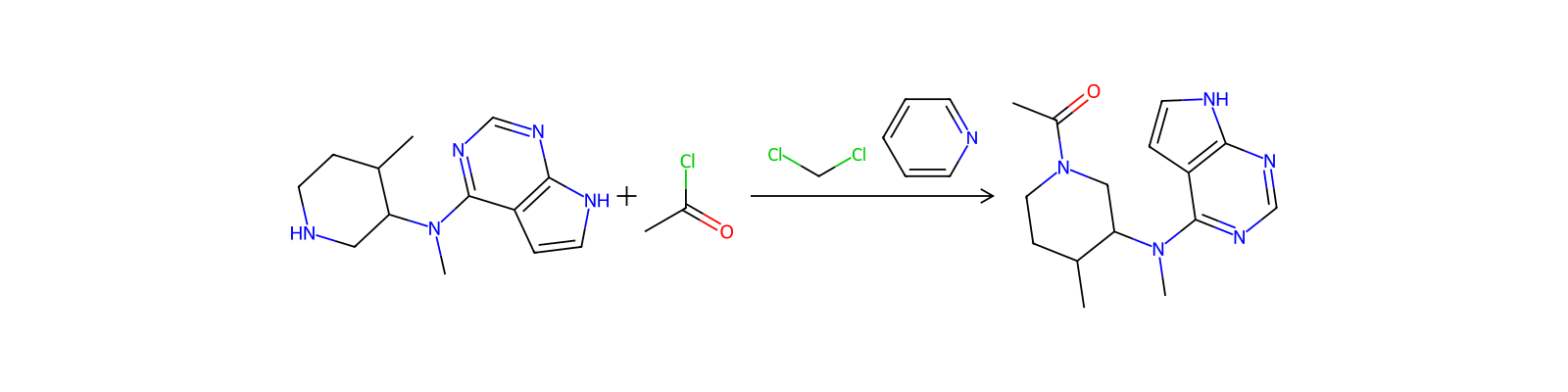
[CH3:1][N:2]([CH:12]1[CH:17]([CH3:18])[CH2:16][CH2:15][NH:14][CH2:13]1)[C:3]1[C:4]2[CH:11]=[CH:10][NH:9][C:5]=2[N:6]=[CH:7][N:8]=1.[C:19](Cl)(=[O:21])[CH3:20]>ClCCl.N1C=CC=CC=1>[CH3:18][CH:17]1[CH2:16][CH2:15][N:14]([C:19](=[O:21])[CH3:20])[CH2:13][CH:12]1[N:2]([CH3:1])[C:3]1[C:4]2[CH:11]=[CH:10][NH:9][C:5]=2[N:6]=[CH:7][N:8]=1Participants
4
Reactant 2


Product 1

Reagents, catalysts & solvents 1

Procedure
To a stirred solution of the product from Method C (0.03 grams, 0.114 mmol) dissolved in 5 mL of 10:1 dichloromethane/pyridine was added (0.018 grams, 0.28 mmol) of acetylchloride and the resulting mixture stirred at room temperature for 18 hours. The reaction mixture was then partitioned between dichloromethane and saturated sodium bicarbonate (NaHCO3). The organic layer was washed again with saturated NaHCO3, dried over sodium sulfate and concentrated to dryness in vacuo. The residue was purified by preparative thin layer chromatography (PTLC) (silica; 4% methanol in dichloromethane) affording 0.005 mg (15%) of the title compound as a colorless oil. LRMS: 288.1 (M+1).
Workup
- customThe reaction mixture was then partitioned between dichloromethane and saturated sodium bicarbonate (NaHCO3)
- washThe organic layer was washed again with saturated NaHCO3
- dry with materialdried over sodium sulfate
- concentrationconcentrated to dryness in vacuo
- customThe residue was purified by preparative thin layer chromatography (PTLC) (silica; 4% methanol in dichloromethane)
Sources & evidence
- ORD record
- ord-05efa6c1a65e4d3daa873ef8797fdeff
- Source dataset
- uspto-grants-2007_09
- Patent number
- US07265221B2
Reaction notes
Loading…