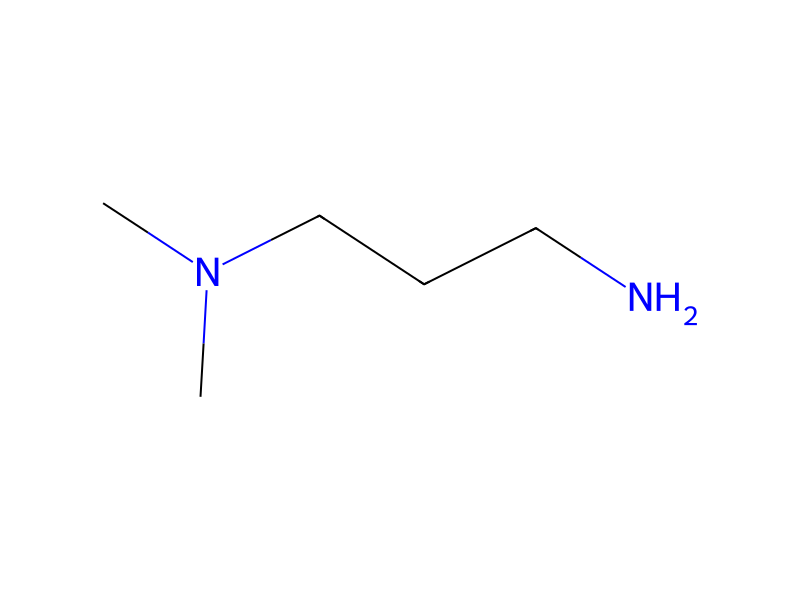
N,N-Dimethyl-1,3-propanediamine → HCID 21506083, compound
Reaction equation

Cl[C:2]1[C:10]([S:11](=[O:14])(=[O:13])[NH2:12])=[CH:9][C:5]([C:6]([OH:8])=[O:7])=[CH:4][C:3]=1[N+:15]([O-:17])=[O:16].[CH3:18][N:19]([CH3:24])[CH2:20][CH2:21][CH2:22][NH2:23]>O>[CH3:18][N:19]([CH3:24])[CH2:20][CH2:21][CH2:22][NH:23][C:2]1[C:10]([S:11](=[O:14])(=[O:13])[NH2:12])=[CH:9][C:5]([C:6]([OH:8])=[O:7])=[CH:4][C:3]=1[N+:15]([O-:17])=[O:16]Participants
4
Reactant 2

Product 1

Reagents, catalysts & solvents 1

Conditions
- Temperature
- 100 °C
Procedure
To a suspension of 4-chloro-3-nitro-5-sulphamyl-benzoic acid (22.4 g) in water (24 ml), 3-dimethylaminopropylamine (120 ml) was added, while cooling. Then the reaction mixture was heated to 100°C and kept at this temperature for 2 hours. After cooling and evaporating in vacuo to dryness, the residue was dissolved in water (80 ml) and adjusted to a pH of 7.5 by addition of 4N hydrochloric acid. The precipitated 4-(3-dimethylaminopropylamino)-3-nitro-5-sulphamyl-benzoic acid was collected by suction and recrystallized from water. The melting point was 262°C (decomp.).
Workup
- additionwas added
- temperaturewhile cooling
- temperatureAfter cooling
- customevaporating in vacuo to dryness
- dissolutionthe residue was dissolved in water (80 ml)
- additionadjusted to a pH of 7.5 by addition of 4N hydrochloric acid
- customThe precipitated 4-(3-dimethylaminopropylamino)-3-nitro-5-sulphamyl-benzoic acid was collected by suction
- customrecrystallized from water
Sources & evidence
- ORD record
- ord-a828cb37884f428f868e9189bbf05889
- Source dataset
- uspto-grants-1976_07
- Patent number
- US03971819
Reaction notes
Loading…