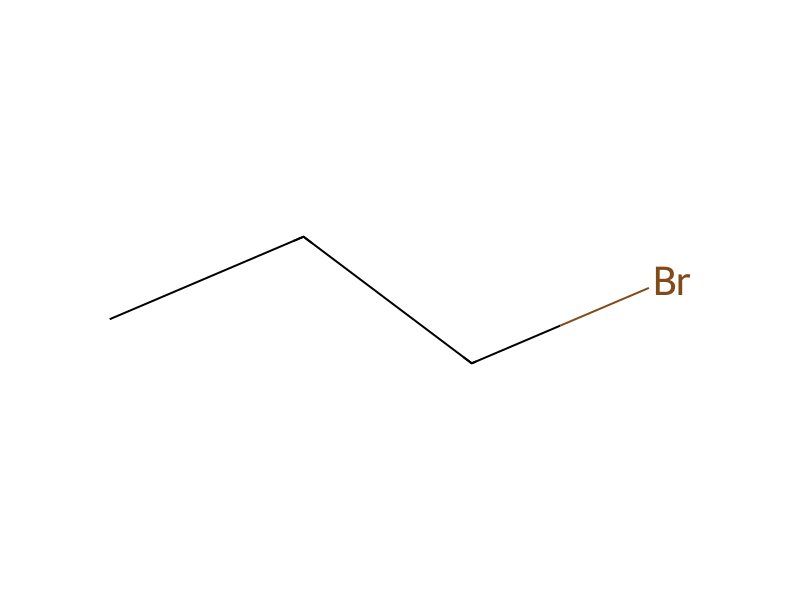
1-Bromopropane → HCID 131734975, compound
Reaction equation

[Cl:1][C:2]1[N:3]=[CH:4][NH:5][C:6]=1[Cl:7].[OH-].[K+].[Br:10][CH2:11][CH2:12][CH3:13].Cl.ClC[C:17]1[CH:26]=[CH:25][C:24]2[C:19](=[CH:20][CH:21]=CC=2)N=1>C(#N)C>[CH2:11]([N:5]1[C:6]2[C:24](=[CH:19][CH:20]=[CH:21][CH:2]=2)[CH:25]=[C:26]([CH3:17])[CH2:4]1)[CH2:12][CH3:13].[Br-:10].[Cl:1][C:2]1[NH:3][CH:4]=[NH+:5][C:6]=1[Cl:7]Participants
6
Reactant 4



Product 1

Reagents, catalysts & solvents 1

Procedure
4,5-Dichloroimidazole (1.23 g, 9 mmol) will be dissolved into acetonitrile. Potassium hydroxide (0.61 g, 9.9 mmol) will be added and the mixture will be allowed to stir for 0.5 h. 1-bromopropane (9 mmol) will be added and the solution will be allowed to reflux overnight. The solution will be filtered hot to remove a white precipitate (presumed to be KBr). 2-chloromethylquinoline hydrochloride (9 mmol) will be dissolved into acetonitrile along with an equivalent of base. This mixture will be added to the previous mixture will be returned to reflux overnight. The mixture will be allowed to cool to room temperature, resulting in a yellow/white precipitate.
Workup
- temperatureto reflux overnight
- filtrationThe solution will be filtered hot
- customto remove a white precipitate (presumed to be KBr)
- additionThis mixture will be added to the previous mixture
- temperatureto reflux overnight
- customresulting in a yellow/white precipitate
Sources & evidence
- ORD record
- ord-3d8b9db166404a9786f58a3c6e20cc56
- Source dataset
- uspto-grants-2016_03
- Patent number
- US09278951B2
Reaction notes
Loading…