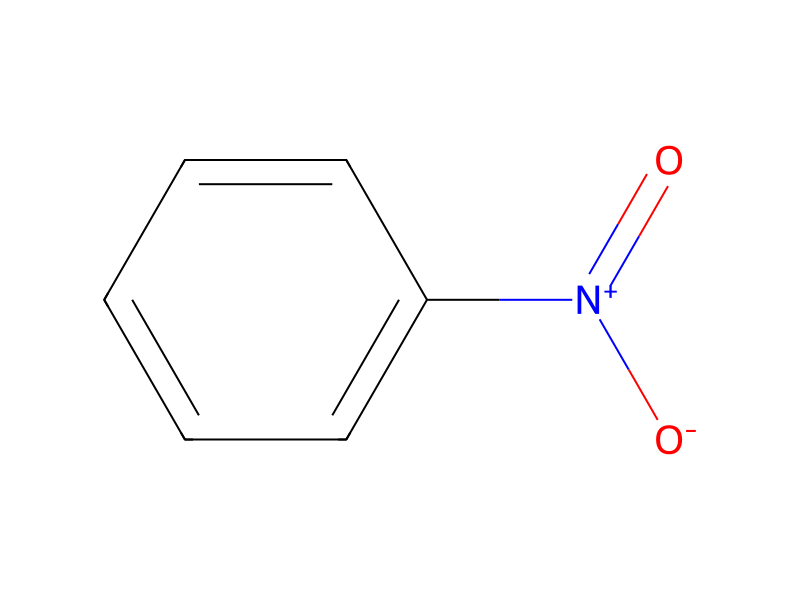
Benzene → Nitrobenzene
Reaction equation

S(=O)(=O)(O)O.[N+:6]([O-:9])(O)=[O:7].[CH:10]1[CH:15]=[CH:14][CH:13]=[CH:12][CH:11]=1>>[N+:6]([C:10]1[CH:15]=[CH:14][CH:13]=[CH:12][CH:11]=1)([O-:9])=[O:7]Participants



Procedure
A sulfuric acid stream (11*)=(a.2.2), a nitric acid stream (12*)=(a.3.2), optionally a fresh benzene stream (13*) and the organic phase (21)=(d.2.1) from the tank (10) are fed into a reactor (1*). Once all the nitric acid has reacted with the benzene to give nitrobenzene under adiabatic reaction conditions, the reaction product (14*), now at a temperature of approx. 130° C., is fed into a phase separation apparatus (2*), in which the reaction product (14*) separates into an organic phase ((15*)=(b.2.2)=crude nitrobenzene, comprising benzene and low boilers in addition to nitrobenzene) and an aqueous phase ((16*)=(b.1.2)=waste acid, still comprising small proportions of nitrobenzene and benzene in addition to sulfuric acid). The aqueous phase (16*)=(b.1.2), comprising mainly sulfuric acid, is combined with the phase (16)=(b.1.1), comprising mainly sulfuric acid, of the upstream nitration of fresh benzene in the first nitration unit, and together they are subjected to a flash evaporation of water in the evaporator (3) by sudden pressure reduction, and are also thereby concentrated. The concentrated sulfuric acid (17) is stored in the sulfuric acid tank (4) until it is re-used. After separation in the phase separation apparatus (2*), the crude nitrobenzene (15*)=(b.2.2) is freed of low boilers and a proportionate amount of benzene in a distillation column (7*). This can be done by direct or indirect heating with steam. The bottom product (24)=(b.2.2), poor in aliphatic organic compounds and comprising nitrobenzene, which was not withdrawn at the top of the distillation column (7*), is combined with the crude nitrobenzene stream (15)=(b.2.1), and together they are cooled to approx. 50° C. in the crude nitrobenzene cooler (5) and fed into the washer (6). In this variant there is thus no recycle benzene stream in the classical sense. However, there is a recycle benzene stream (d.2)=(21) from step d), which originates from the distillation of the combined crude nitrobenzene streams (b.2.1)=(15) and (b.2.2)=(24) and is processed in the second nitration unit. The top product (23) (the low-boiler stream) of the distillation column (7*) is temporarily stored in the buffer tank (25).
Sources & evidence
- ORD record
- ord-5820b8c36b3441778d01dad1df054dae
- Source dataset
- uspto-grants-2016_03
- Patent number
- US09284255B2
Reaction notes
Loading…