Glycine ethyl ester → {[8-((R)-1-phenyl-propylcarbamoyl)-3,4-dihydro-1H-pyrrolo[2,1-c][1,4]oxazine-6-carbonyl]-amino}-acetic acid ethyl ester
Reaction equation

[C:1]1([C@H:7]([NH:10][C:11]([C:13]2[CH:14]=[C:15]([C:22]([OH:24])=O)[N:16]3[CH2:21][CH2:20][O:19][CH2:18][C:17]=23)=[O:12])[CH2:8][CH3:9])[CH:6]=[CH:5][CH:4]=[CH:3][CH:2]=1.ON1C2C=CC=CC=2N=N1.Cl.C(N=C=NCCCN(C)C)C.[CH2:47]([O:49][C:50](=[O:53])[CH2:51][NH2:52])[CH3:48]>CN(C)C=O.ClCCl>[CH2:47]([O:49][C:50](=[O:53])[CH2:51][NH:52][C:22]([C:15]1[N:16]2[C:17]([CH2:18][O:19][CH2:20][CH2:21]2)=[C:13]([C:11](=[O:12])[NH:10][C@@H:7]([C:1]2[CH:2]=[CH:3][CH:4]=[CH:5][CH:6]=2)[CH2:8][CH3:9])[CH:14]=1)=[O:24])[CH3:48]Participants
Reactant 4
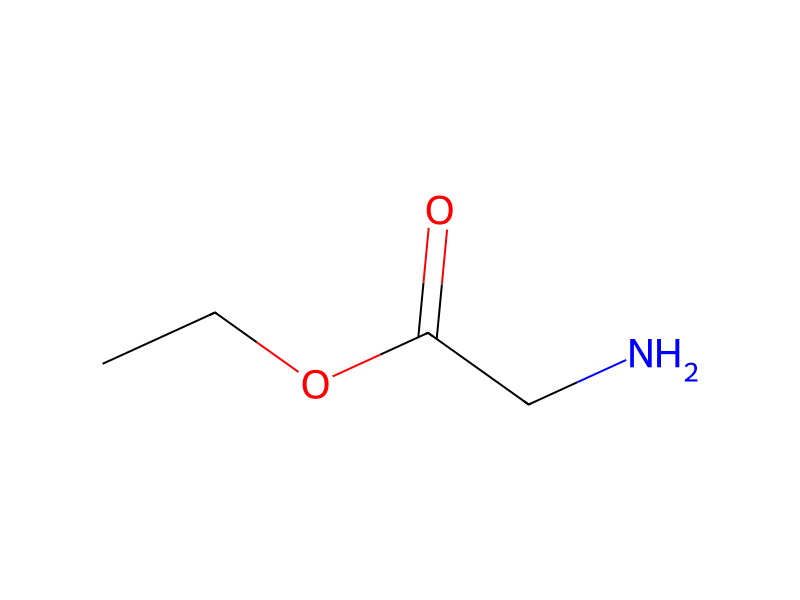



Product 1

Reagents, catalysts & solvents 2


Conditions
- Temperature
- 40 °C
Procedure
To a solution of 8-((R)-1-phenyl-propylcarbamoyl)-3,4-dihydro-1H-pyrrolo[2,1-c][1,4]oxazine-6-carboxylic acid (Comp. No. 11a) (50 mg, 0.168 mmol) in dimethylformamide (1.7 ml) was added 1-hydroxybenzotriazole (23 mg, 0.168 mmol) and 1-ethyl-3-(3-dimethylaminopropyl)carbodiimide hydrochloride (32 mg, 0.168 mmol). The mixture was stirred for 1 h at 40° C., then amino-acetic acid ethyl ester (17 mg, 0.168 mmol) was added and the mixture was stirred at 25° C. overnight. Excess dichloromethane was added and the mixture was washed consecutively with water, aqueous sodium hydrogencarbonate and brine. The organic layer was evaporated to dryness. The residue was dissolved in a small amount of acetonitrile, excess water was added and the solution was freeze-dried to give 52 mg (82%) of {[8-((R)-1-phenyl-propylcarbamoyl)-3,4-dihydro-1H-pyrrolo[2,1-c][1,4]oxazine-6-carbonyl]-amino}-acetic acid ethyl ester. LC/MS (method 4): Rt=1.19 min; m/z=414.2 (M+H+). 1H-NMR: δ (ppm)=8.46 (1H, t), 8.21 (1H, d), 7.35-7.36 (3H, m), 7.30 (2H, t), 7.21 (1H, t), 4.91 (2H, dd), 4.82 (1H, q), 4.19 (2H, t), 4.11 (2H, q), 3.90-3.92 (4H, m), 1.71-1.83 (2H, m), 1.21 (3H, t), 0.88 (3H, t).
Workup
- stirringthe mixture was stirred at 25° C. overnight
- washthe mixture was washed consecutively with water, aqueous sodium hydrogencarbonate and brine
- customThe organic layer was evaporated to dryness
- dissolutionThe residue was dissolved in a small amount of acetonitrile, excess water
- additionwas added
- customthe solution was freeze-dried
Sources & evidence
- ORD record
- ord-5c73a33b0f4b49adafea1ce3c1cb44f8
- Source dataset
- uspto-grants-2016_03
- Patent number
- US09284333B2
Reaction notes
Loading…