HuagongsheHuagongshe Chemistry Print Report · For research reference only
HRID 931069Generated: October 28, 2026
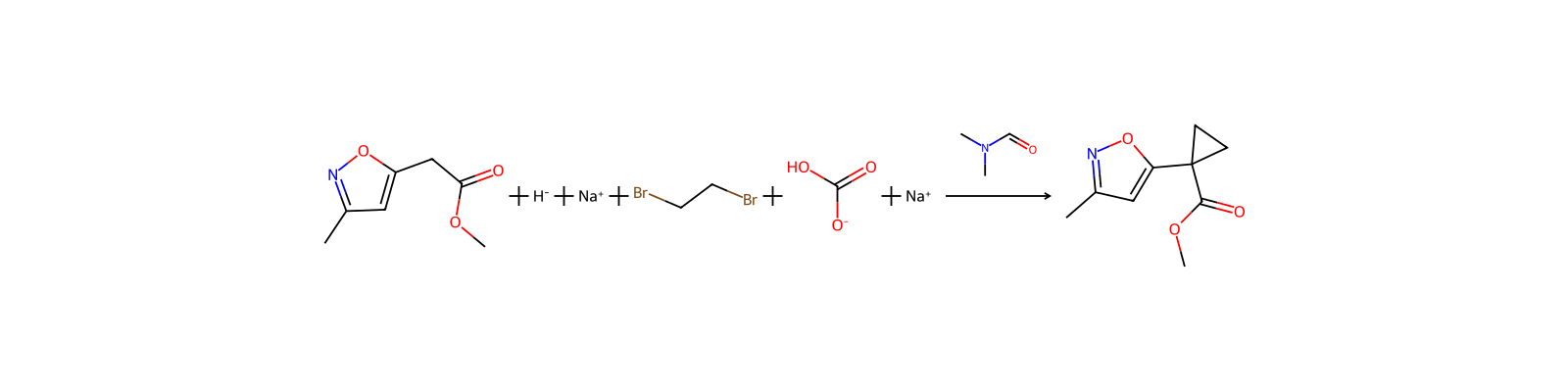
1,2-Dibromoethane → Methyl 1-(3-methylisoxazol-5-yl)cyclopropanecarboxylate
https://huagongshe.com/reaction/931069
Participants
| Role | Name | HCID | Charge |
|---|
| Reactant | 1,2-Dibromoethane | HCID 7839 | — |
| Reactant | Sodium hydride | HCID 24758 | — |
| Reactant | Sodium Bicarbonate | HCID 516892 | — |
| Reactant | Methyl 2-(3-methylisoxazol-5-yl)acetate | HCID 12366875 | — |
| Solvent | Dimethylformamide | HCID 6228 | — |
| Product | Methyl 1-(3-methylisoxazol-5-yl)cyclopropanecarboxylate | HCID 89853625 | — |
Reaction Steps
Into a 15 mL round bottom flask was added methyl 2-(3-methylisoxazol-5-yl)acetate (250 mg, 1.61 mmol) dissolved in N,N-dimethylformamide (7 mL) followed by addition of sodium hydride (60% suspension in mineral oil, 322 mg, 8.06 mmol). The mixture was stirred at room temperature for 15 minutes. 1,2-Dibromoethane (417 μL, 4.83 mmol) was added dropwise. The reaction mixture was stirred at room temperature for 18 h. A saturated aqueous solution of sodium bicarbonate was added to the mixture and it was extracted with dichloromethane (3×). The combined organics were washed with brine, dried over sodium sulfate, filtered and concentrated under reduced pressure. The residue was dissolved in dichloromethane (1.5 mL) and washed (3×) with an aqueous (10%) lithium chloride solution to remove residues of N,N-dimethylformamide. The organics were dried over sodium sulfate, decanted and concentrated under reduced pressure to afford methyl 1-(3-methylisoxazol-5-yl)cyclopropanecarboxylate MS (ES+) (M+H) 182.0; LCMS retention time: 2.53 minutes (Method L). The material was used for the next step without further purification.
Provenance & Evidence
| DOI | 10.6084/m9.figshare.5104873.v1 |
|---|
| Patent number | US09296745B2 |
|---|
| Source dataset | uspto-grants-2016_03 |
|---|
| ORD ID | ord-ed29fe56eda4482289792036b2f06559 |
|---|
| Source note | uspto-grants-2016_03 |
|---|