Water → N-(3-bromo-7-iodo-5',6'-dihydrospiro[chromeno[2,3-b]pyridine-5,4'-[1,3]oxazin]-2'-yl)benzamide
Reaction equation

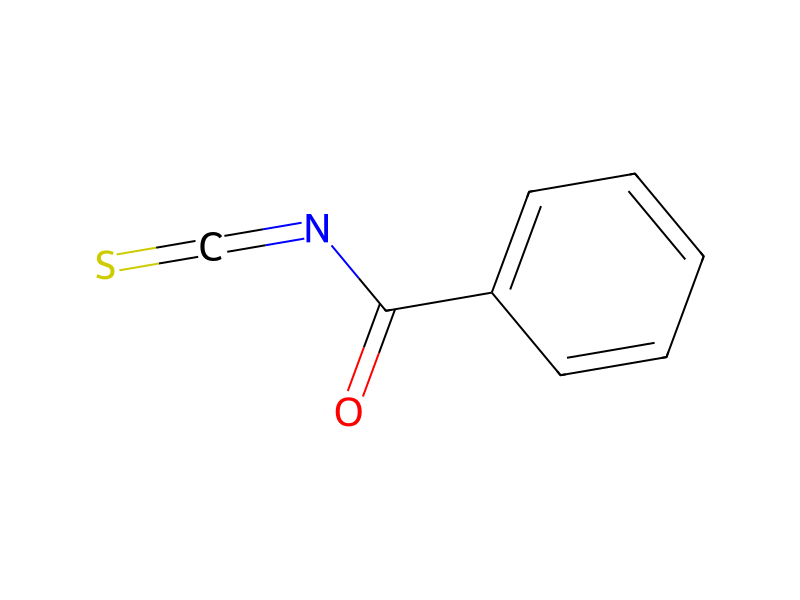
[NH2:1][C:2]1([CH2:18][CH2:19][OH:20])[C:15]2[C:10](=[N:11][CH:12]=[C:13]([Br:16])[CH:14]=2)[O:9][C:8]2[C:3]1=[CH:4][C:5]([I:17])=[CH:6][CH:7]=2.[C:21]([N:29]=[C:30]=S)(=[O:28])[C:22]1[CH:27]=[CH:26][CH:25]=[CH:24][CH:23]=1.C1CCC(N=C=NC2CCCCC2)CC1.O>C1COCC1>[Br:16][C:13]1[CH:14]=[C:15]2[C:2]3([CH2:18][CH2:19][O:20][C:30]([NH:29][C:21](=[O:28])[C:22]4[CH:27]=[CH:26][CH:25]=[CH:24][CH:23]=4)=[N:1]3)[C:3]3[C:8](=[CH:7][CH:6]=[C:5]([I:17])[CH:4]=3)[O:9][C:10]2=[N:11][CH:12]=1Participants
Reactant 4



Product 1

Reagents, catalysts & solvents 1

Conditions
- Temperature
- 80 °C
Procedure
In a 250-mL flask, the 2-(5-amino-3-bromo-7-iodo-5H-chromeno[2,3-b]pyridin-5-yl)ethanol (2.24 g, 5.01 mmol) was dissolved in THF (30 mL). Benzoyl isothiocyanate (0.607 mL, 4.51 mmol) was added. After 1 h, the mixture was concentrated. The residue was taken up in ACN (30 mL), and catalytic TEA (0.069 mL, 0.501 mmol) was added, followed by DCC (1.137 g, 5.51 mmol). A water-cooled condenser was affixed, and the solution was stirred in an 80° C. oil bath for 2 h. The reaction was then concentrated. The residue was used directly in the next step without further purification or purified by column chromatography (silica gel, 10-50% EtOAc/hexanes) to obtain N-(3-bromo-7-iodo-5′,6′-dihydrospiro[chromeno[2,3-b]pyridine-5,4′-[1,3]oxazin]-2′-yl)benzamide as a yellow solid. MS (m/z) 575.8/577.7 (M+H)+.
Workup
- concentrationthe mixture was concentrated
- concentrationThe reaction was then concentrated
- customThe residue was used directly in the next step without further purification
- custompurified by column chromatography (silica gel, 10-50% EtOAc/hexanes)
Sources & evidence
- ORD record
- ord-1a63f70292c1432c80648e2c7c3bbf99
- Source dataset
- uspto-grants-2016_03
- Patent number
- US09296759B2
Reaction notes
Loading…