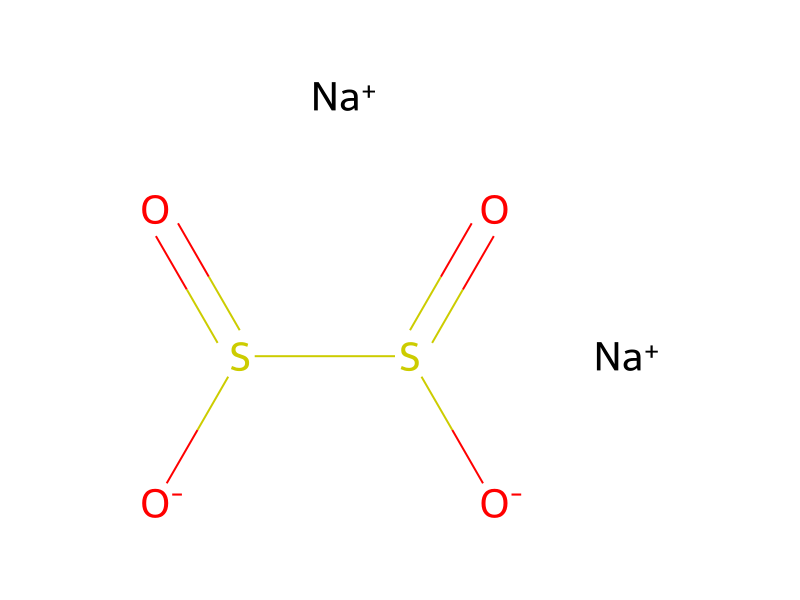
Sodium Dithionite → 7-bromo-N4-(4-chlorobutyl)quinoline-3,4-diamine
Reaction equation

[Br:1][C:2]1[CH:11]=[C:10]2[C:5]([C:6]([NH:15][CH2:16][CH2:17][CH2:18][CH2:19][Cl:20])=[C:7]([N+:12]([O-])=O)[CH:8]=[N:9]2)=[CH:4][CH:3]=1.S(S([O-])=O)([O-])=O.[Na+].[Na+]>CO.O>[Br:1][C:2]1[CH:11]=[C:10]2[C:5]([C:6]([NH:15][CH2:16][CH2:17][CH2:18][CH2:19][Cl:20])=[C:7]([NH2:12])[CH:8]=[N:9]2)=[CH:4][CH:3]=1Participants
Reactant 2

Product 1

Reagents, catalysts & solvents 2


Conditions
- Temperature
- 0 °C
Procedure
A suspension of (7-bromo-3-nitroquinolin-4-yl)-(4-chlorobutyl)amine (8.05 g, 22.5 mmol) in methanol (250 mL) was cooled to 0° C.; a solution of sodium hydrosulfite (19.5 g, 112 mmol) in water (80 mL) was added dropwise over a period of 30 minutes. The reaction was stirred at ambient temperature for two hours and then concentrated under reduced pressure. The residue was partitioned between dichloromethane (300 mL) and aqueous sodium bicarbonate (150 mL of 50%). The aqueous layer was separated and extracted with dichloromethane (2×50 mL). The combined organic fractions were dried over magnesium sulfate, filtered, and concentrated under reduced pressure to provide 7.25 g of crude 7-bromo-N4-(4-chlorobutyl)quinoline-3,4-diamine as a light brown semi-solid.
Workup
- concentrationconcentrated under reduced pressure
- customThe residue was partitioned between dichloromethane (300 mL) and aqueous sodium bicarbonate (150 mL of 50%)
- customThe aqueous layer was separated
- extractionextracted with dichloromethane (2×50 mL)
- dry with materialThe combined organic fractions were dried over magnesium sulfate
- filtrationfiltered
- concentrationconcentrated under reduced pressure
Sources & evidence
- ORD record
- ord-440122c60b11499ca2604e0ffa81145b
- Source dataset
- uspto-grants-2006_08
- Patent number
- US07091214B2
Reaction notes
Loading…