Adenine → 2-chloro-N-(3-iodobenzyl)-7H-purin-6-amine
Reaction equation

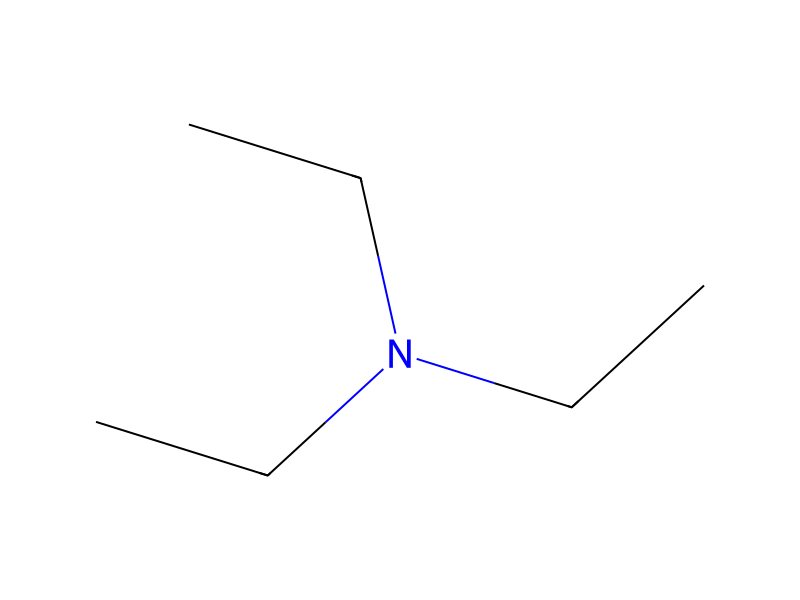
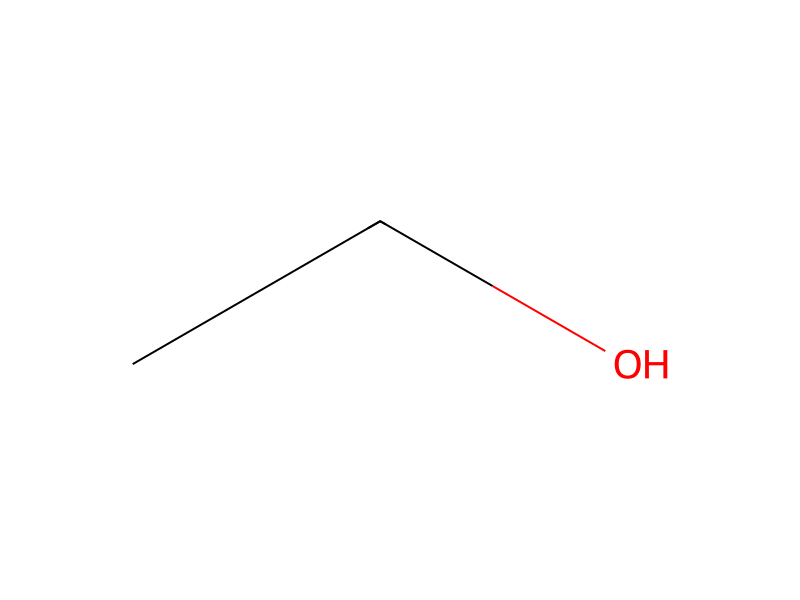
N1C(N)=C2C(N=CN2)=NC=1.[Cl:11][C:12]1[N:20]=[C:19]2[C:15]([NH:16][CH:17]=[N:18]2)=[C:14](Cl)[N:13]=1.Cl.[I:23][C:24]1[CH:25]=[C:26]([CH:29]=[CH:30][CH:31]=1)[CH2:27][NH2:28].C(N(CC)CC)C>C(O)C>[I:23][C:24]1[CH:25]=[C:26]([CH:29]=[CH:30][CH:31]=1)[CH2:27][NH:28][C:14]1[N:13]=[C:12]([Cl:11])[N:20]=[C:19]2[C:15]=1[NH:16][CH:17]=[N:18]2Participants
Reactant 4



Product 1

Reagents, catalysts & solvents 1
Procedure
N6 -(3-iodobenzyl)-2-substituted adenosine derivatives can be synthesized from the corresponding adenine derivative. 2,6-Dichloropurine reacted with 3-iodobenzylamine hydrochloride in the presence of triethylamine in ethanol at room temperature provides N6 -(3-iodobenzyl)-2-chloroadenine, which can be silylated before coupling to yield the silylated derivative. The glycosidic bond is formed upon treatment of the 1'-O-acetyl riboside derivative N-methyl 1-O-acetyl-2,3-dibenzoyl-β-D-ribofuronamide with the aforesaid 9-silylated adenine derivative in the presence of TMSOTf as a Lewis acid catalyst. Condensation of N-methyl 1-O-methyl-2,3-dibenzoyl-β-D-ribofuronamide with the aforesaid 9-silylated adenine derivative produces ribose ring-opened product. Benzoyl groups of 2-chloro-N6 -(3-iodobenzyl)-9-[5-(methylamido)-2,3-di-O-benzoyl-β-D-ribofuranosyl]-adenine are deprotected with NH3 /MeOH to produce 2-chloro-N6 -(3-iodobenzyl)-9-[5-(methylamido)-β-D-ribofuranosyl]-adenine, which reacted with various nucleophiles such as methylamine/THF and sodium thiomethoxide/DME yield compounds N6 -(3-iodobenzyl)-2-methylamino-9-[5-(methylamido)-β-D-ribofuranosyl]-adenine and N6 -(3-iodobenzyl)-2-methylthio-9-[5-(methylamido)-β-D-ribofuranosyl]-adenine. The benzoyl groups of 2-chloro-N6 -(3-iodobenzyl)-9-[2,3,5-tri-O-benzoyl-β-D-ribofuranosyl]-adenine can be similarly deprotected to produce the riboside derivative 2-chloro-N6 -(3-iodobenzyl)-9-[β-D-ribofuranosyl]-adenine.
Sources & evidence
- ORD record
- ord-1b78cfa1830a426a838494d7ef0b8f98
- Source dataset
- uspto-grants-1998_06
- Patent number
- US05773423
Reaction notes
Loading…