Acetic Anhydride → Phthalic Anhydride
Reaction equation

[NH-][C:2]1[CH:10]=[CH:9][CH:8]=[C:4]([C:5]([OH:7])=O)[C:3]=1[C:11]([OH:13])=[O:12].C([O-])(=O)C.[Na+].C(OC(=O)C)(=O)C>>[C:5]1(=[O:7])[O:13][C:11](=[O:12])[C:3]2=[CH:2][CH:10]=[CH:9][CH:8]=[C:4]12Participants
4



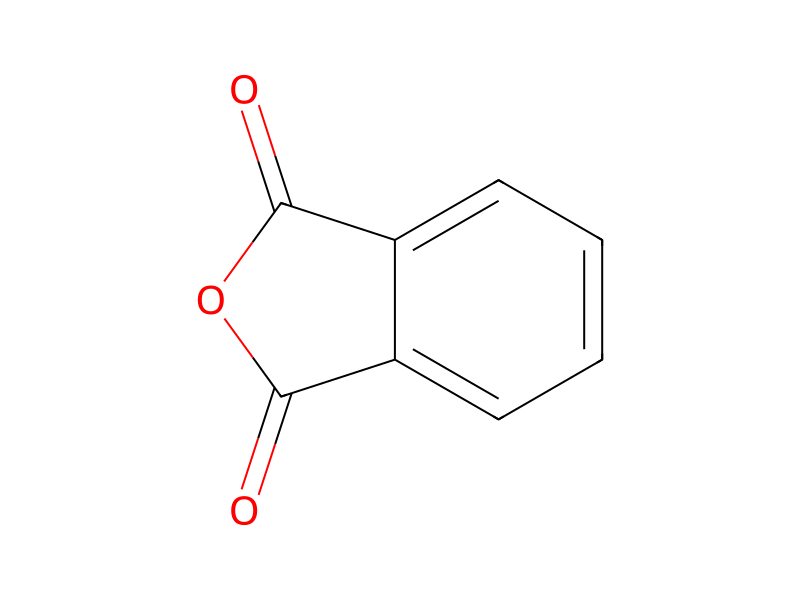
Conditions
- Temperature
- 80 °C
Procedure
13.8 g (0.04 mol) of this amidylphthalic acid are mixed with 1.4 g of anhydrous sodium acetate and 25 ml of acetic anhydride and the mixture is heated to 80° C. for 30 minutes, whilst stirring. The resulting reaction solution is evaporated to dryness, the residue is extracted with 60 ml of hot benzene and the benzene solution is filtered using animal charcoal. After evaporating the benzene, the residue is dried for 24 hours at 60° C./0.05 mm Hg. 9.95 g (80% theory) of crystalline 3-(bicyclo[1.2.2]hept-5-ene-2,3-dicarboxylic acid imidyl)-phthalic anhydride are obtained; melting point 178°-180° C.
Workup
- customThe resulting reaction solution
- customis evaporated to dryness
- extractionthe residue is extracted with 60 ml of hot benzene
- filtrationthe benzene solution is filtered
- customAfter evaporating the benzene
- customthe residue is dried for 24 hours at 60° C./0.05 mm Hg
Sources & evidence
- ORD record
- ord-011c2e89705146d38a1631c794a9a5c0
- Source dataset
- uspto-grants-1979_07
- Patent number
- US04160081
Reaction notes
Loading…