Dichloromaleic anhydride → 3-(2',3'-Dichloromaleinimidyl)-phthalic anhydride
Reaction equation

[Cl:1][C:2]1[C:3]([O:5][C:6](=O)[C:7]=1[Cl:8])=[O:4].[NH2:10][C:11]1[CH:19]=[CH:18][CH:17]=[C:13]([C:14]([OH:16])=O)[C:12]=1[C:20]([OH:22])=[O:21]>O1CCOCC1>[Cl:1][C:2]1[C:3]([N:10]([C:11]2[CH:19]=[CH:18][CH:17]=[C:13]3[C:14]([O:22][C:20](=[O:21])[C:12]=23)=[O:16])[C:6](=[O:5])[C:7]=1[Cl:8])=[O:4]Participants
4
Reactant 2
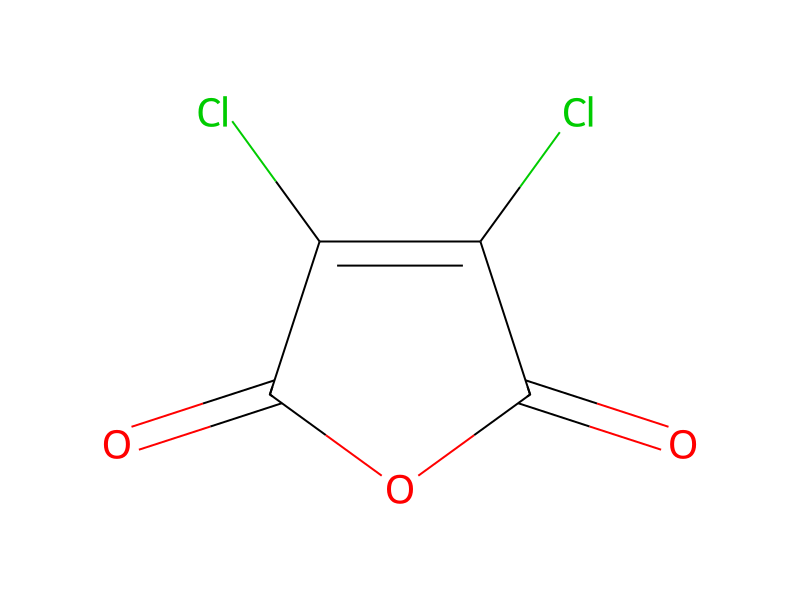

Product 1

Reagents, catalysts & solvents 1

Conditions
- Temperature
- 130 °C
Procedure
20 g (0.12 mol) of 2,3-dichloromaleic anhydride are added to a solution of 18.1 g (0.1 mol) of 3-aminophthalic acid in 90 ml of dioxane. The reaction mixture is stirred at 20°-30° C., whereupon a clear solution is produced over the course of approx. 30 minutes. The dioxane is then distilled off in vacuo (20 mm Hg) and the oil which remains is warmed to 130° C. After 3 hours, the crystalline mass is cooled to 50° C. and mixed with 100 ml of ethyl acetate. The reaction product is filtered off at 10° C. and dried in vacuo at 80° C. 18.1 g (58% of theory) of crystalline 3-(2',3'-dichloromaleinimidyl)-phthalic anhydride are obtained, melting at 229°-230° C. after recrystallisation from anhydrous acetic acid.
Workup
- customis produced over the course of approx. 30 minutes
- distillationThe dioxane is then distilled off in vacuo (20 mm Hg)
- temperaturethe crystalline mass is cooled to 50° C.
- additionmixed with 100 ml of ethyl acetate
- filtrationThe reaction product is filtered off at 10° C.
- customdried in vacuo at 80° C
Sources & evidence
- ORD record
- ord-84befe9e196f415c9c6d094ff9d42414
- Source dataset
- uspto-grants-1979_07
- Patent number
- US04160081
Reaction notes
Loading…