Participants
| Role | Name | HCID | Charge |
|---|
| Reactant | Ammonia | HCID 222 | — |
| Reactant | m-Xylyl bromide | HCID 12099 | — |
| Reactant | Ammonium Chloride | HCID 25517 | — |
| Reactant | Magnesium | HCID 5462224 | — |
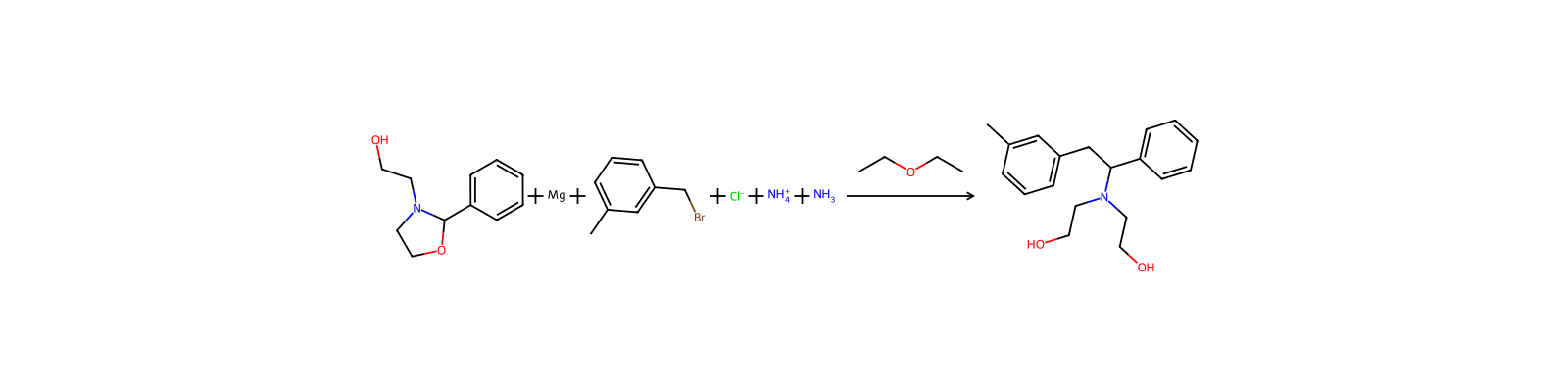
| Reactant | 2-(2-Phenyl-1,3-oxazolidin-3-yl)ethan-1-ol | HCID 12648663 | — |
| Solvent | Diethyl Ether | HCID 3283 | — |
| Product | HCID 20396937 | HCID 20396937 | 82.7% |
Reaction Steps
A solution of 3-(2-hydroxyethyl)-2-phenyloxazolidine (78 g) in anhydrous ether (300 ml) is added dropwise with stirring to Grignard reagent which is prepared from magnesium turnings (22 g) and m-methylbenzylbromide (150 g) in anhydrous ether (1200 ml), and the mixture is refluxed for 3 hours. After the reaction, the reaction mixture is decomposed with an ammonium chloride aqueous solution, and made alkaline with ammonia. The ether layer is separated and extracted with an excess amount of 10% hydrochloric acid. The aqueous layer is separated and made alkaline with sodium hydroxide and extracted with chloroform. The chloroform layer is dried over anhydrous sodium sulfate, and the solvent is distilled off to give crude dl-N,N-bis(2-hydroxyethyl)-1-phenyl-2-(3-tolyl)ethylamine (100 g) as an oily substance.
Provenance & Evidence
| DOI | 10.6084/m9.figshare.5104873.v1 |
|---|
| Patent number | US04162316 |
|---|
| Source dataset | uspto-grants-1979_07 |
|---|
| ORD ID | ord-fb98f85cb0594e08841dda1a199f6da2 |
|---|
| Source note | uspto-grants-1979_07 |
|---|