13-Ethinyl-17beta-hydroxy-10-methyl-gon-4-en-3-one → 13-Ethinyl-10-methyl-gon-4-ene-3,17-dione
Reaction equation

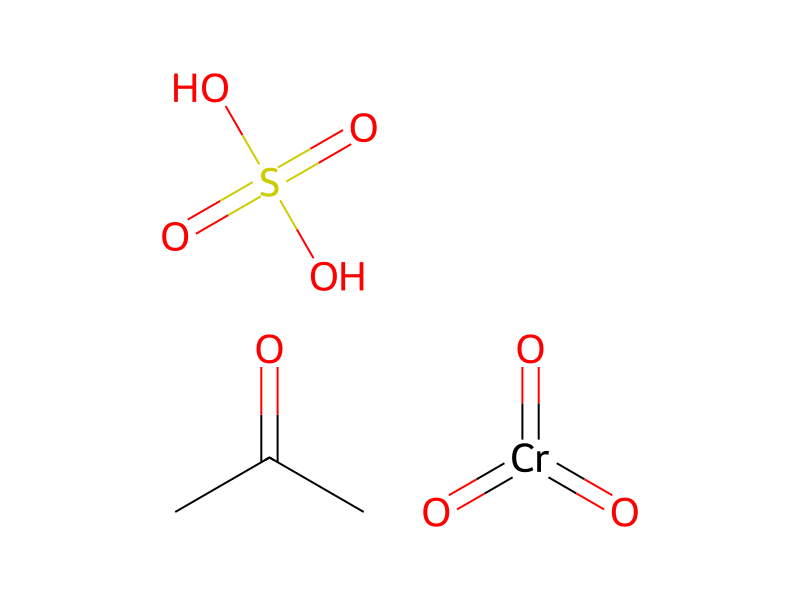
CC(C)=O.OS(O)(=O)=O.O=[Cr](=O)=O.[C:14]([C@:16]12[CH2:24][CH2:23][C@@H:22]3[C@:25]4([CH3:34])[C:30]([CH2:31][CH2:32][C@H:21]3[C@@H:20]1[CH2:19][CH2:18][C@@H:17]2[OH:35])=[CH:29][C:28](=[O:33])[CH2:27][CH2:26]4)#[CH:15]>CC(C)=O>[C:14]([C@:16]12[CH2:24][CH2:23][C@@H:22]3[C@:25]4([CH3:34])[C:30]([CH2:31][CH2:32][C@H:21]3[C@@H:20]1[CH2:19][CH2:18][C:17]2=[O:35])=[CH:29][C:28](=[O:33])[CH2:27][CH2:26]4)#[CH:15]Participants
4
Reactant 2

Product 1

Reagents, catalysts & solvents 1

Conditions
- Temperature
- 0 °C
Procedure
A small excess of Jones reagent (8 N chromic acid in sulphuric acid) is added to a solution of 300 mg of 13-ethinyl-17β-hyroxy-10-methyl-gon-4-en-3-one in 4 ml of acetone at 0° C. The reaction mixture is stirred for a further 5 minutes at 0° C and the excess reagent is destroyed by adding isopropyl alcohol. The reaction mixture is diluted with ethyl acetate, washed with water, sodium bicarbonate solution and saturated sodium chloride solution, dried and evaporated. The residue is chromatographed on silica gel; elution with a mixture of hexne/ethyl acetate (3:1) gives 13-ethinyl-10-methyl-gon-4-ene-3,17-dione, which is identical to the product of Examples 1C and 3.
Workup
- customthe excess reagent is destroyed
- additionby adding isopropyl alcohol
- additionThe reaction mixture is diluted with ethyl acetate
- washwashed with water, sodium bicarbonate solution and saturated sodium chloride solution
- customdried
- customevaporated
- customThe residue is chromatographed on silica gel
- washelution
- additionwith a mixture of hexne/ethyl acetate (3:1)
Sources & evidence
- ORD record
- ord-cf45c2afbab6410883afd2fe3274555a
- Source dataset
- uspto-grants-1977_10
- Patent number
- US04052421
Reaction notes
Loading…