Participants
| Role | Name | HCID | Charge |
|---|
| Reactant | Piperidine | HCID 8082 | — |
| Reactant | HCID 12665764 | HCID 12665764 | — |
| Solvent | Ethanol | HCID 702 | — |
| Product | HCID 20327618 | HCID 20327618 | — |
Reaction Steps
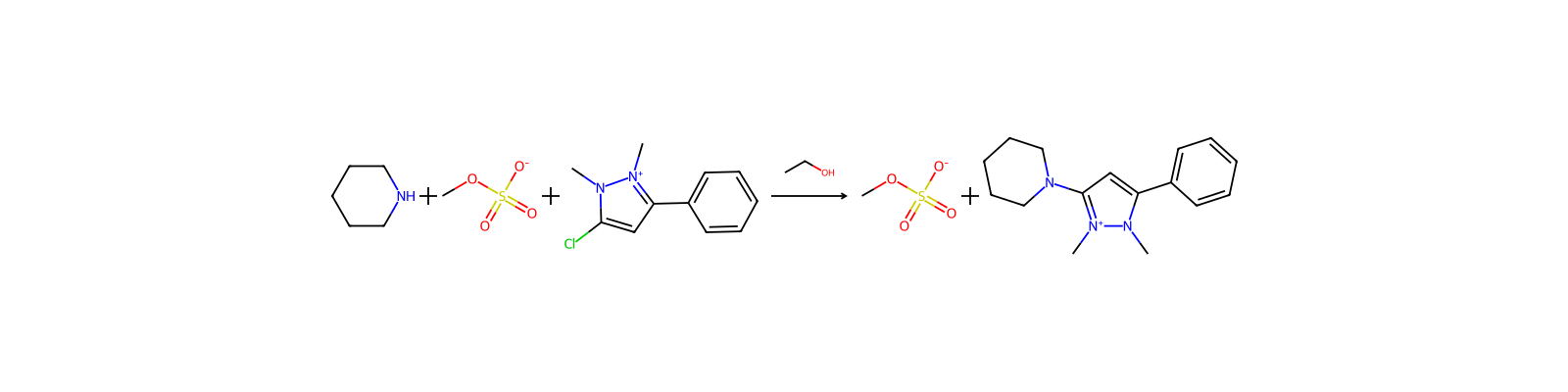
Piperidine (2.56 g, 0.03 mole) is added to 1,2-dimethy 3-chloro-5-phenylpyrazolium methyl sulfate (4.77 g, 0.015 mole) in absolute ethanol (30 ml) and the mixture stirred with a bar magnet and heated under reflux for 4 hours. After cooling, the reaction mixture is evaporated under reduced pressure to a brown oil, and then dissolved in 50 ml of aqueous saturated sodium bicarbonate solution. The aqueous layer is extracted with ether and this organic layer discarded, then with chloroform (3×100 ml). Evaporation of the chloroform layer affords 1,2-dimethyl-3-phenyl-5-piperidinopyrazolium methyl sulfate as a viscous oil. The oil is redissolved in water and saturated aqueous potassium iodide solution is added. (Sodium iodide is also equally effective). An immediate copious white precipitate of 1,2-dimethyl-3-phenyl-5-piperidinopyrazolium iodide is formed, then filtered and washed with ice cold water to give 3.37 g, (56%) of product mp 179° C. to 180° C. The melting point is unchanged by dissolving in chloroform, filtering and reprecipitating with diethyl ether and filtering off the solid. For analysis see Table I, compound 1.
Provenance & Evidence
| DOI | 10.6084/m9.figshare.5104873.v1 |
|---|
| Patent number | US04053610 |
|---|
| Source dataset | uspto-grants-1977_10 |
|---|
| ORD ID | ord-a040ea9dc0ec43639ddaf3b1b6055860 |
|---|
| Source note | uspto-grants-1977_10 |
|---|