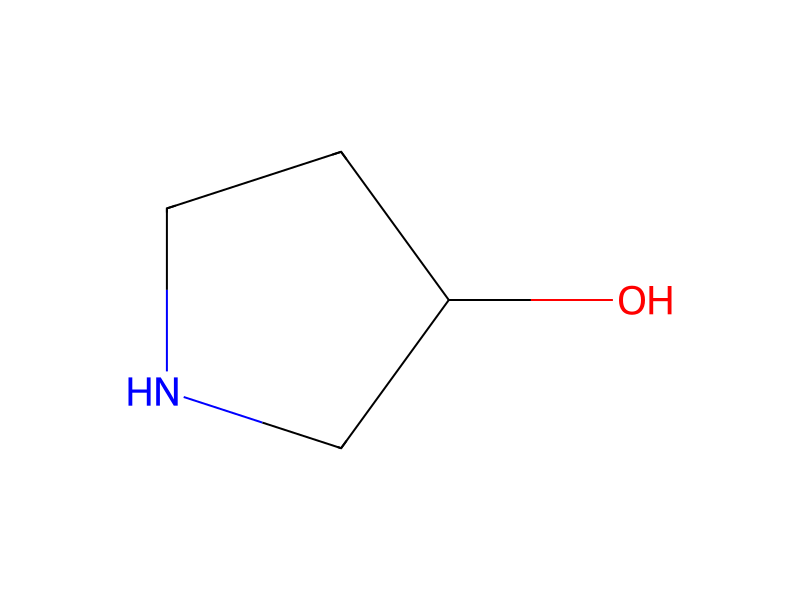
4-Hydroxypyrrolidine → 1-Cyclopropyl-6,8-difluoro-7-(3-hydroxypyrrolidin-1-yl)-4-oxo-quinoline-3-carboxylic acid
Reaction equation

[CH:1]1([N:4]2[C:13]3[C:8](=[CH:9][C:10]([F:16])=[C:11](F)[C:12]=3[F:14])[C:7](=[O:17])[C:6]([C:18]([OH:20])=[O:19])=[CH:5]2)[CH2:3][CH2:2]1.[OH:21][CH:22]1[CH2:26][CH2:25][NH:24][CH2:23]1>C(#N)C>[CH:1]1([N:4]2[C:13]3[C:8](=[CH:9][C:10]([F:16])=[C:11]([N:24]4[CH2:25][CH2:26][CH:22]([OH:21])[CH2:23]4)[C:12]=3[F:14])[C:7](=[O:17])[C:6]([C:18]([OH:20])=[O:19])=[CH:5]2)[CH2:3][CH2:2]1Participants
4
Reactant 2

Product 1

Reagents, catalysts & solvents 1

Procedure
A mixture of 2.1 g (7.8 mmol) of 1-cyclopropyl-6,7,8-trifluoro-1,4-dihydro-4-oxo-3-quinoline carboxylic acid, 20 ml acetonitrile, 1.2 g (7.8 mmole) 1,8-diazobicyclo[5.4.0]undec-7-ene and 0.7 g (7.8 mmole) of 3-hydroxypyrrolidine was refluxed for 2.5 hours. The reaction was allowed to cool and stirred at room temperature for 48 hours. The resulting precipitate was filtered, washed with diethyl ether, then taken up in isopropyl alcohol. The solid was filtered and washed with ether until dry to give 2.0 g of the title compound, mp 276°-278° C.
Workup
- temperaturewas refluxed for 2.5 hours
- temperatureto cool
- filtrationThe resulting precipitate was filtered
- washwashed with diethyl ether
- filtrationThe solid was filtered
- washwashed with ether
- customuntil dry
Sources & evidence
- ORD record
- ord-3afccf74138644c68cfdfffc61a84e43
- Source dataset
- uspto-grants-1987_05
- Patent number
- US04663457
Reaction notes
Loading…