Benzenesulfonic Acid → L-Proline 1,1-dimethylethyl ester
Reaction equation

[NH:1]1[CH2:8][CH2:7][CH2:6][C@H:2]1[C:3]([OH:5])=[O:4].C1(S(O)(=O)=O)C=CC=CC=1.[CH3:19][C:20](=[CH2:22])[CH3:21].[OH-].[Na+]>C(Cl)Cl>[NH:1]1[CH2:8][CH2:7][CH2:6][C@H:2]1[C:3]([O:5][C:20]([CH3:22])([CH3:21])[CH3:19])=[O:4]Participants
Reactant 4



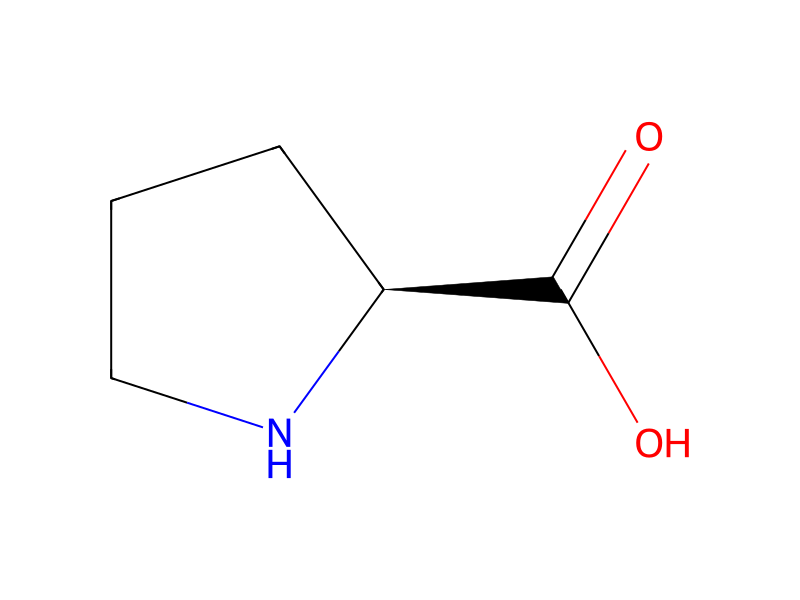
Product 1

Reagents, catalysts & solvents 1

Conditions
- Temperature
- 5 °C
Procedure
To a 12L round-bottomed flask fitted with a mechanical stirrer, high efficiency reflux condenser (≤-10° C.), adJustable diptube inlet, and overhead nitrogen bubbler was charged a slurry of L-proline (600 g, 5.22 mole) in methylene chloride (6.0L, K.F.≤0.01%). The slurry was cooled to 5° C. and maintained at <20° C. as benzenesulfonic acid (1.24 kg, 7.83 mole) was slowly added. The reaction mixture, now homogeneous, was further cooled under nitrogen to 0°-5° C. and liquefied isobutylene (5.86L, 67.8 mole) was added subsurface via the diptube over 2 hours. The batch was then aged for 3 days at 5° C. under nitrogen. Upon completion, the batch was slowly quenched under nitrogen into well-stirred cold (0°-5° C.) aqueous sodium hydroxide (15.6L, 1.0 molar, 15.6 moles). The biphasic mixture was stirred for 10 minutes after which, the layers were allowed to separate. The pH of the aqueous layer measured 12-13. The lower methylene chloride layer was removed and set aside. The upper aqueous layer was then reextracted with methylene chloride (2×2.0L). The methylene chloride extracts were combined and concentrated under vacuum at ≤25° C. to a volume of 6.0L. The batch was then washed with aqueous sodium hydroxide (2×4.0L, 0.3 molar, 2.4 moles). The aqueous wash layers were combined and subsequently extracted with methylene chloride (2L). The methylene chloride extracts were then combined, dried over sodium sulfate (500 g), filtered, and concentrated under vacuum at ≤25° C. to about 1.5L (cf.50% soln K.F.≤0.06%). The batch was stored cold (0°-5° C.) under nitrogen. The concentrated product must be kept at 0°-5° C. to avoid exothermic decomposition.
Workup
- temperaturehigh efficiency reflux condenser (≤-10° C.), adJustable diptube inlet, and overhead nitrogen bubbler
- additionwas slowly added
- temperatureThe reaction mixture, now homogeneous, was further cooled under nitrogen to 0°-5° C.
- customUpon completion, the batch was slowly quenched under nitrogen
- customto separate
- customThe lower methylene chloride layer was removed
- concentrationconcentrated under vacuum at ≤25° C. to a volume of 6.0L
- extractionsubsequently extracted with methylene chloride (2L)
- dry with materialdried over sodium sulfate (500 g)
- filtrationfiltered
- concentrationconcentrated under vacuum at ≤25° C. to about 1.5L (cf
- custom(0°-5° C.)
- custommust be kept at 0°-5° C.
Sources & evidence
- ORD record
- ord-68feba15f25d45feaf231cee86c84846
- Source dataset
- uspto-grants-1991_02
- Patent number
- US04992541
Reaction notes
Loading…