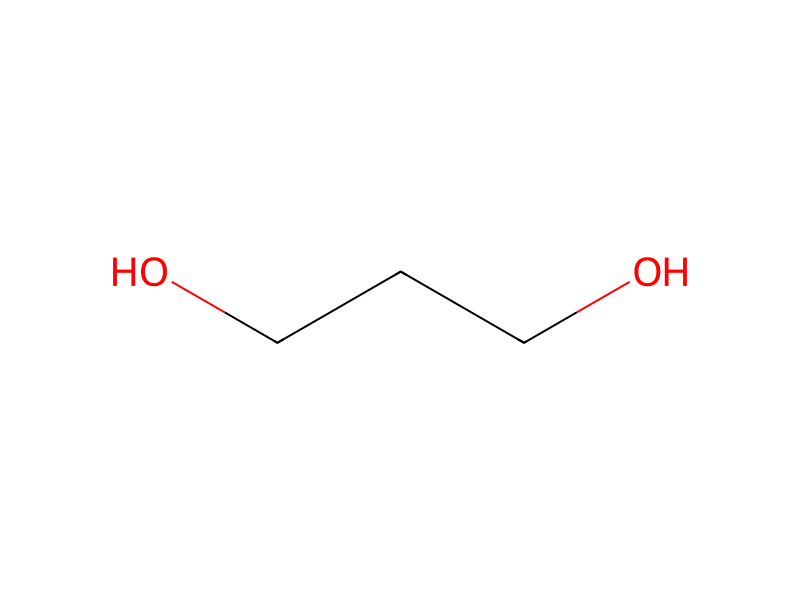
1,3-Propanediol → 4-(1,3-Dioxan-2-yl)-2-nitrophenol
Reaction equation

[OH:1][C:2]1[CH:9]=[CH:8][C:5]([CH:6]=[O:7])=[CH:4][C:3]=1[N+:10]([O-:12])=[O:11].[CH2:13](O)[CH2:14][CH2:15][OH:16].C1(C)C=CC(S(O)(=O)=O)=CC=1.[NH+]1C=CC=CC=1>C1(C)C=CC=CC=1>[O:7]1[CH2:13][CH2:14][CH2:15][O:16][CH:6]1[C:5]1[CH:8]=[CH:9][C:2]([OH:1])=[C:3]([N+:10]([O-:12])=[O:11])[CH:4]=1Participants
5
Reactant 3


Product 1

Reagents, catalysts & solvents 1

Procedure
A mixture of 8 g of 4-hydroxy-3-nitrobenzaldehyde, 16 g of 1,3-propanediol, a catalytic amount of pyridinium p-toluenesulfonic acid and 250 ml of toluene was azeotropically dehydrated with heating under reflux. The reaction mixture was cooled, washed with water, dried over anhydrous magnesium sulfate and then concentrated under reduced pressure. The residue was recrystallized from toluene-n-hexane to obtain 9.2 g of 4-(1,3-dioxan-2-yl)-2-nitrophenol.
Workup
- temperaturewith heating
- temperatureunder reflux
- temperatureThe reaction mixture was cooled
- washwashed with water
- dry with materialdried over anhydrous magnesium sulfate
- concentrationconcentrated under reduced pressure
- customThe residue was recrystallized from toluene-n-hexane
Sources & evidence
- ORD record
- ord-3eb4efb3b3cf42d7b5e0386c4c253654
- Source dataset
- uspto-grants-1991_02
- Patent number
- US04994479
Reaction notes
Loading…