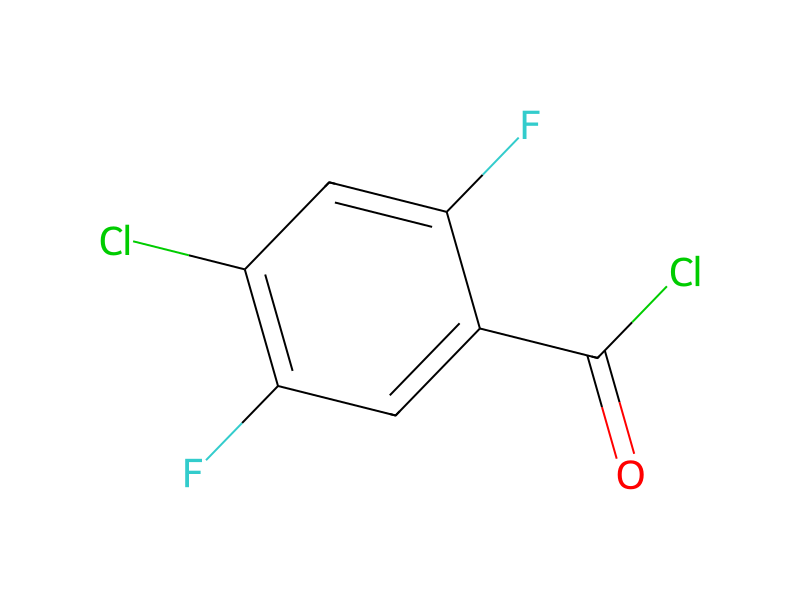
Thionyl Chloride → 4-Chloro-2,5-difluorobenzoyl chloride
Reaction equation

[Cl:1][C:2]1[C:10]([F:11])=[CH:9][C:5]([C:6](O)=[O:7])=[C:4]([F:12])[CH:3]=1.S(Cl)([Cl:15])=O>O>[Cl:1][C:2]1[C:10]([F:11])=[CH:9][C:5]([C:6]([Cl:15])=[O:7])=[C:4]([F:12])[CH:3]=1Participants
4
Reactant 2


Product 1
Reagents, catalysts & solvents 1

Conditions
- Temperature
- 60 °C
Procedure
38.5 g 4-chloro-2,5-difluorobenzoic acid (0.2 mole) was placed in a 250 mL, 3-necked roundbottom flask equipped with a magnetic stirbar, a thermometer, and a water-cooled condenser. 238 g thionyl chloride was added in one lot. The mixture was stirred and heated on a water bath. At about 58°-60° C. the solid dissolved with evolution of gas and formation of foam. The mixture was stirred and maintained at 60° C. until all the solid dissolved - about 30 minutes. It was then heated in a boiling water bath to reflux and held there for 2 hours.
Workup
- customequipped with a magnetic stirbar
- temperatureheated on a water bath
- dissolutionAt about 58°-60° C. the solid dissolved with evolution of gas and formation of foam
- stirringThe mixture was stirred
- dissolutiondissolved - about 30 minutes
- temperatureIt was then heated in a boiling water bath
- temperatureto reflux
Sources & evidence
- ORD record
- ord-67fd2ab4e04f4e7fa74abddc288608d8
- Source dataset
- uspto-grants-1991_02
- Patent number
- US04996355
Reaction notes
Loading…