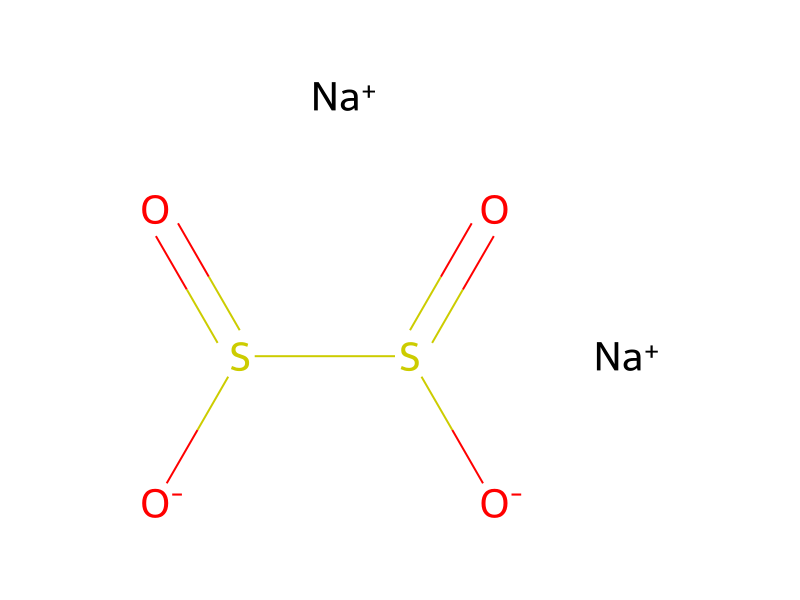
Sodium Dithionite → 4-fluoro-2-methyl-1H-indol-5-ol
Reaction equation

[F:1][C:2]1[C:7]([OH:8])=[CH:6][CH:5]=[C:4]([N+:9]([O-])=O)[C:3]=1[CH2:12][C:13](=O)[CH3:14].S(S([O-])=O)([O-])=O.[Na+].[Na+]>O>[F:1][C:2]1[C:7]([OH:8])=[CH:6][CH:5]=[C:4]2[C:3]=1[CH:12]=[C:13]([CH3:14])[NH:9]2Participants
Reactant 2

Product 1

Reagents, catalysts & solvents 1

Procedure
1-(2-fluoro-3-hydroxy-6-nitrophenyl)-propan-2-one from previous step (50 g, 0.234 mol) was added to 2 liter round bottom flask. Water (1 L) was added, and the yellow suspension was stirred at RT. Sodium dithionite (225 g, 5.5 eq) was added in one portion and the reaction mixture was stirred and kept <30° C. until HPLC analysis indicated no starting material remained (typically less than 1 hour). Upon completion, the reaction mixture was cooled to 0° C. and the tan solid product was collected by vacuum filtration. The wet product was dried at <50° C. under house vacuum to afford 4-fluoro-2-methyl-1H-indol-5-ol (31.4 g, 81% yield) which was isolated as a tan crystalline powder. The material had an HPLC purity of >99.8. 1H NMR (CDCl3, 400 MHz) δ 7.8 (s, 1H), 6.9−6.7 (m, 2H), 6.2 (s, 1H), 4.7 (s, 1H), 2.4 (s, 3H).
Workup
- stirringthe reaction mixture was stirred
- customkept <30° C. until HPLC analysis
- customtypically less than 1 hour
- temperatureUpon completion, the reaction mixture was cooled to 0° C.
- filtrationthe tan solid product was collected by vacuum filtration
- customThe wet product was dried at <50° C. under house vacuum
Sources & evidence
- ORD record
- ord-2e8d506009154be5a253ef4d83070f58
- Source dataset
- uspto-grants-2005_03
- Patent number
- US06869952B2
Reaction notes
Loading…