Quinoline → 2-Bromomethyl-5-[1-(4-chlorophenoxy)-2-methylprop-2-yl]-5-methyl-tetrahydrofuran
Reaction equation

[Br:1]Br.[Cl:3][C:4]1[CH:21]=[CH:20][C:7]([O:8][CH2:9][C:10]([CH3:19])([CH3:18])[C:11]([OH:17])([CH3:16])[CH2:12][CH2:13][CH:14]=[CH2:15])=[CH:6][CH:5]=1.N1C2C(=CC=CC=2)C=CC=1>C(Cl)(Cl)Cl>[Br:1][CH2:15][CH:14]1[CH2:13][CH2:12][C:11]([C:10]([CH3:19])([CH3:18])[CH2:9][O:8][C:7]2[CH:20]=[CH:21][C:4]([Cl:3])=[CH:5][CH:6]=2)([CH3:16])[O:17]1Participants
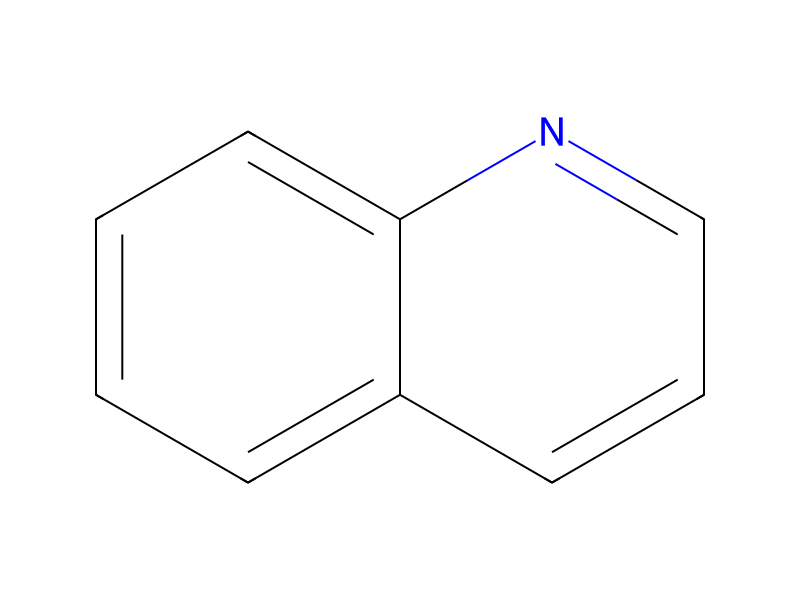




Procedure
16 g (0.1 mole) of bromine are added dropwise to 28.2 g (0.1 mole) of 7-(4-chlorophenoxy)-5-hydroxy-5,6,6-trimethyl-hept-1-ene in 200 ml of absolute chloroform at room temperature, with stirring, followed by 13 g (0.1 mole) of quinoline, at -10° C. with cooling. The reaction mixture is stirred at room temperature for a further 2 hours and concentrated in vacuo, the residue is taken up in ether, the mixture is filtered and concentrated again in vacuo and the residue is stirred at 95° C. on a water-bath for 1 hour. The resulting mixture is taken up in ether and filtered and the filtrate is washed with 15% strength hydrochloric acid and then with water, dried over sodium sulphate and freed from the solvent in vacuo. 32.7 g (90% of theory) of 2-bromomethyl-5-[1-(4-chlorophenoxy)-2-methylprop-2-yl]-5-methyl-tetrahydrofuran are obtained as an oil, which can be used in the next stage without further purification. ##STR142##
Workup
- temperaturewith cooling
- stirringThe reaction mixture is stirred at room temperature for a further 2 hours
- concentrationconcentrated in vacuo
- filtrationthe mixture is filtered
- concentrationconcentrated again in vacuo
- stirringthe residue is stirred at 95° C. on a water-bath for 1 hour
- filtrationfiltered
- washthe filtrate is washed with 15% strength hydrochloric acid
- dry with materialwith water, dried over sodium sulphate
Sources & evidence
- ORD record
- ord-abbff69ade774437a3577f9313e6587e
- Source dataset
- uspto-grants-1987_12
- Patent number
- US04713379
Reaction notes
Loading…